Mr. Prasetyo was first diagnosed with nasopharyngeal and thyroid cancers in October 2024. Initially, he suffered repeated nosebleeds. A biopsy revealed a malignant, poorly differentiated, non-keratinizing squamous cell carcinoma of the nasopharynx. A lump in his thyroid was also found to be malignant on biopsy: papillary thyroid carcinoma with a low degree of malignancy. Mr. Prasetyo’s nasopharyngeal cancer was among the most aggressive types, which generally respond well to chemotherapy and radiation, as well as ECCT electric-field therapy. Treatment caused the cancer mass to shrink rapidly. The problem, however, is that this type of cancer can grow back quickly even after shrinking; it can enter the lymphatic system and bloodstream, spreading to other organs. For that reason, he underwent chemo and radiation to reduce the cancer mass quickly, then continued with ECCT to clear any remaining cells and provide long-term protection against recurrence and spread. He did not undergo conventional medical treatment for the thyroid mass, relying only on ECCT. The thyroid lump shrank slowly, in keeping with its low-grade characteristics and slower response to electric-field therapy.
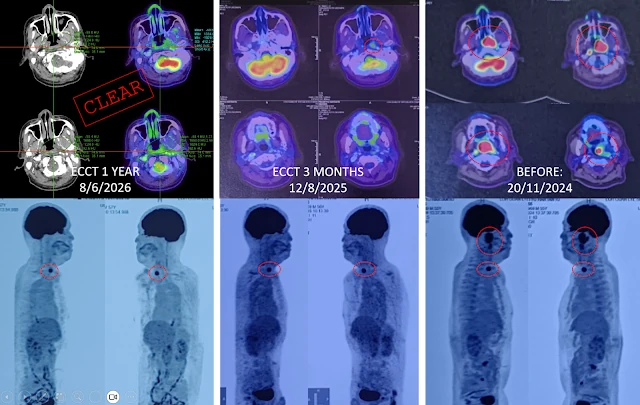
IMAGE: From right to left, PET scans before ECCT, after three months of ECCT, and after one year of ECCT use.
***
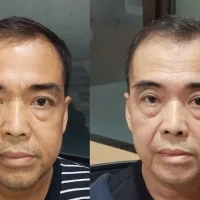
Mr. Prasetyo asked, “Can the bags under my eyes go away too?” “Yes, if your body fat drops below 12%,” came the reply. At least within six months, the wrinkles on his face had almost disappeared, his face looked firmer and fresher, and the bags under his eyes had diminished.
Mr. Prasetyo was not undergoing a “facelift” program to tighten his face. He was in recovery from the grip of two malignant cancers at once, hidden behind that face: nasopharyngeal and thyroid cancers.
At first, he experienced frequent nosebleeds. In October 2024, he went to a hospital in Jakarta for examinations and a biopsy. The biopsy revealed a malignant squamous cell carcinoma of the nasopharynx. A lump was also visible in his thyroid, and its biopsy likewise confirmed a malignancy: papillary thyroid carcinoma, a type of thyroid cancer with a low grade of malignancy.
Mr. Prasetyo’s nasopharyngeal cancer was among the most aggressive types. This type of cancer tends to be soft rather than tough and generally responds well to chemotherapy, radiation, and ECCT electric-field therapy. Because of its softer cellular structure, the dead cells break down easily and being eliminated or absorbed by the immune system, allowing the cancer mass to shrink relatively quickly.
However, because of its high grade, a cancer mass that has shrunk can grow back rapidly. Its soft nature also allows these cells to spread easily into lymphatic tissue and the bloodstream, then grow in other organs. Chemo and radiation are generally no longer effective once cells have spread to organs that are difficult for blood vessels to reach, or when increasing the radiation dose would risk damaging other vital organs.
That is why long-term protection—killing small numbers of cells that have entered the bloodstream or lymphatic tissue without risking damage to organ function or the body’s overall balance—is key to achieving remission and recovery to normal health. ECCT electric-field therapy meets those criteria. Chemo and radiation can be used initially to shrink the cancer mass rapidly, followed by ECCT to clear remaining cells and provide long-term protection, with the aim of achieving optimal remission and recovery.
Mr. Prasetyo underwent chemotherapy and radiation for the nasopharyngeal mass in Malaysia. Nothing had yet been done to treat the thyroid mass. The nasopharyngeal mass shrank significantly after nine rounds of chemotherapy and 33 radiation sessions. On MRI and PET scans from November 2024, it had originally filled the left nasopharyngeal cavity and extended into the right nasopharynx and the airway below it. By the CT scan in February 2025, it had shrunk to less than 2 cm.
Mucus was still draining from his nose, which was taken as a sign that the mass had not completely cleared and could potentially grow again. Side effects of chemotherapy and radiation included loss of his sense of smell, numbness on the left side of his body, lightheadedness when rising from a seated position, and dry mouth. Chemo and radiation could not continue indefinitely as long-term protection because of their effects on the body as a whole. Mr. Prasetyo therefore decided to try ECCT to clear any remaining cells, prevent recurrence and spread, and speed his recovery from chemo and radiation.
Mr. Prasetyo began using ECCT in April 2025. He received a helmet-shaped device covering his head and neck to reach the nasopharynx, the entire brain, and the lymph nodes in the neck, a common area of spread for high-grade nasopharyngeal cancer. He wore it together with a vest to cover the chest and abdomen and prevent spread to the lungs and liver. He also received another device with an “odd” SpongeBob-like shape. Although it looked strange, this device came from an optimized electromagnetic-field design and calculation intended to provide maximum coverage from the brain to the waist. It was designed to produce a straight, homogeneous electric-field distribution and prevent spread to the spine.
He also received an oscillator program designed to generate an electric field interacting with proteins and microtubules, with the aim of causing immediate cell death within less than 5–15 minutes. Another oscillator program was intended to generate an electric field acting at the cellular level, stimulating membrane-cell receptors associated with immunity and activating T and NK cells to induce cell death through immune pathways (Alamsyah, 2018).
Mr. Prasetyo’s response was quite rapid. A large amount of mucus and nasal discharge came from both nostrils, showing that parts of the mass were still present on both sides of his nasal cavity. He also passed cloudy urine and, early on, had dark or black bowel movements. Stool tests generally showed no abnormalities even when the stool turned black or dark, a common reaction during elimination in high-grade (soft-type) cancers. On one occasion, a lump of thick mucus mixed with black solid material about the size of the tip of an index finger came out, without bleeding; it was thought possibly to have come from the remaining mass. During ECCT use, the passage of mucus and nasal discharge became an easy and relatively accurate indicator of how thoroughly the active cancer mass in the nasal cavity had cleared. The discharge gradually diminished with use of the device and stopped entirely after three months.
A PET scan after three months of ECCT showed that the mass had largely cleared, with a possible residual area of inflammation showing mild FDG uptake in the left nasopharynx, the location of the original mass. There was no visible spread to lymph nodes in the neck—where cancers of this type often spread—or to other organs. As a bonus, the thyroid mass also appeared to have shrunk.
As for the thyroid mass, because its cells were low grade, the response to ECCT’s electric-field therapy was generally slower. High-grade cases such as the nasopharyngeal cancer might shrink significantly within three to six months, whereas a low-grade type like the thyroid cancer could take nine to twelve months to shrink even slightly, and perhaps several years to shrink substantially. Low-grade cancers generally have dead cells that are particularly tough and rich in cholesterol, making them difficult to eliminate through fine blood vessels. With ECCT alone, the mass might shrink gradually or at least stop growing, but complete clearance or remission would probably be difficult without surgery. As long as the mass did not grow and the device continued to be used, it was generally considered safe.
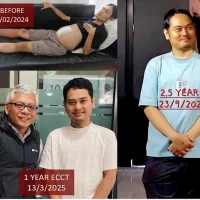
After 1.5 years of using the device, Mr. Prasetyo was relatively well and had returned to normal activities. The side effects of radiation and chemotherapy had disappeared within a few months of using the device. His latest PET scan, taken after a year of ECCT use, showed that the nasopharyngeal mass had largely cleared. There was still an image of tissue at the site of the original mass, possibly scar tissue showing a small amount of FDG uptake. The thyroid mass had also shrunk further.
For the time being, he has not yet been allowed to use the ECBS #CSPORT device to speed up body-fat reduction toward his target of below 12% and eliminate the bags under his eyes. The disappearance of wrinkles, a firmer-looking face, and reduced under-eye bags are only small “bonuses” of his recovery with ECCT.
Wishing Mr. Prasetyo continued good health. (WS)
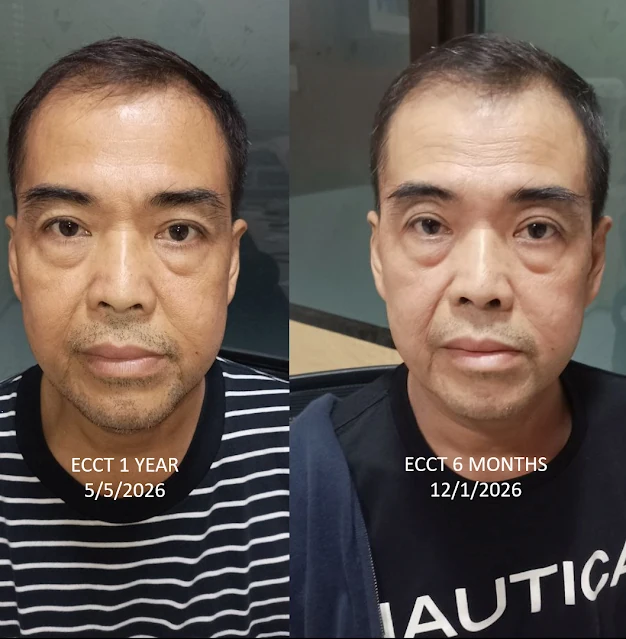
IMAGE: Photos of Mr. Prasetyo after six months of use and after 1.5 years of ECCT use.