Diagnosed with brain cancer 14 years ago, Mrs. Melly experienced extreme headaches that felt as though she were being struck with a hammer or an axe, was unable to see, lost her hearing, and suffered severe amnesia to the point that she could no longer recognize her own home or children. Her doctor said that she would likely not survive for more than four months unless she underwent surgery immediately. An MRI scan in December 2012 showed a malignant tumor identified as a low-grade astrocytoma in the left side of her brain, measuring 3x3x2 cm. Because of the risk that her memory and communication functions might be permanently lost, Mrs. Melly’s husband firmly refused surgery and decided to use ECCT as an alternative treatment. One miracle after another occurred, and to this day she has survived for more than 15 years while “putting the cancer in her brain to sleep” with ECCT, successfully passing through critical periods and returning to a normal condition.
***
Fourteen years ago, Mrs. Melly temporarily lost her sight and hearing and suffered severe amnesia to the point that she could no longer recognize her home, her car, or even her own children. Based on the MRI results, her doctor diagnosed a malignant tumor in the left side of her brain and said that her remaining life expectancy might be only four months if she did not undergo brain surgery immediately.
Of course, she was unable to think about what should be done, whether she should have surgery or what other course to take. In addition to remembering nothing, all she could feel was an excruciating headache, as though she were being struck with a hammer or an axe.
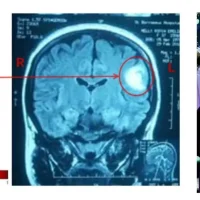
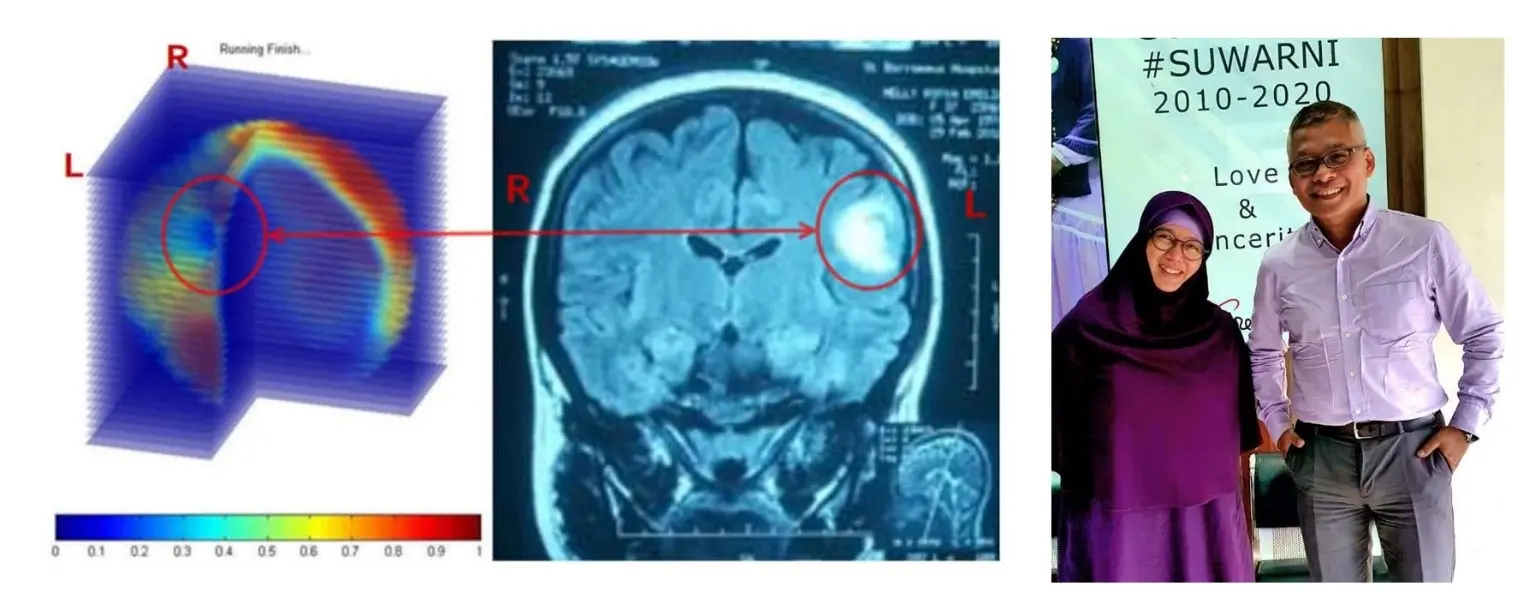
Her right leg and the right side of her body felt weak and could not be moved. An MRI scan in December 2012 showed a malignant tumor identified as a low grade astrocytoma in the left side of her brain, measuring 3x3x2 cm.
Mrs. Melly’s husband, Mr. Rozi, who is a lawyer, firmly refused surgery even though the doctor’s prognosis stated that she would not survive for more than four months. Of course, no one truly knows how long a person will live. He cancelled the surgery and continued searching for a non-surgical alternative until he decided to use ECCT, a non-invasive therapy using a special helmet with electro-capacitive technology. Whether it was driven by complete surrender to Allah, accompanied by the strength of Mr. Rozi’s dhikr as he continued to support Mrs. Melly while she wore the ECCT helmet, one miracle after another occurred. To this day, Mrs. Melly has survived for more than 15 years while “putting the cancer in her brain to sleep,” successfully passing through critical periods and returning to a normal condition.
A slow-growing low-grade astrocytoma (low-grade astrocytoma) located in the transition area between the gyrus frontalis medius and the inferior portion of the left frontal lobe—which includes Broca’s area and the premotor cortex—can cause clinical effects such as language impairment (dysphasia/expressive aphasia), reduced executive function, and seizures. Damage to or compression of this area can affect the ability to speak and verbal fluency. Patients may have difficulty finding the right words, speak haltingly (expressive aphasia), or experience a significant decline in verbal fluency, as Mrs. Melly did.
This area also controls complex movements related to speech, as well as contralateral motor movements of the body, so lesions in this region can disrupt the coordination of the facial and tongue muscles required for articulation. Although low-grade astrocytomas usually do not cause acute vasogenic edema (tissue swelling), the presence of a mass in this location can impair cognitive functions such as planning, working memory, mental flexibility, problem-solving, and impulse control.
Mrs. Melly not only experienced extraordinary pain, but the cancer also gradually consumed her memory until she could no longer remember her own home or children.
She did not experience seizures, but seizures are the most common neurological symptom in patients with low-grade glioma (approximately 95% of cases). Irritation of nerve cells caused by fluid accumulation around a slowly growing tumor often triggers focal seizures, which can sometimes develop into generalized seizures. These seizures are often the only physical sign or symptom before the tumor is investigated and diagnosed further. Compared with high-grade malignant tumors such as glioblastoma, grade 1 or 2 astrocytomas grow infiltratively but create a mass effect by placing pressure on surrounding tissue, with minimal edema. Symptoms caused by increased intracranial pressure—such as headaches that worsen in the morning or nausea—usually occur later or when the tumor has enlarged significantly.
Because this tumor develops slowly, the surrounding brain tissue often adapts by relocating language and motor functions to nearby healthy areas of the brain, an effect known as adaptive plasticity. This may allow patients to avoid severe impairment or sudden paralysis.
Astrocytomas with a low level of malignancy (low grade) generally do not respond very well to radiation or chemotherapy, and surgery is the usual treatment for this type of case. However, because the tumor is located in an area of the brain that regulates language function, total resection surgery could result in permanent language impairment, and the patient’s memory and speech might never return. Partial resection, meanwhile, may be performed in the hope that neural plasticity will help restore declining speech and memory functions, but it carries a high risk of recurrence and the spread of tumor cells into surrounding tissue, potentially leading to repeated surgical procedures.
Because of the risk that her memory and speech might be permanently lost, Mrs. Melly’s husband decided to pursue an alternative route using ECCT. However, the low grade type responds slowly to ECCT therapy. The electric-field effect can stimulate brain nerve cells and help accelerate adaptive neural plasticity, but reducing the tumor’s size generally occurs very slowly, with little or no visible change for one to two years. In comparison, highly malignant cancers (astrocytoma grade 3 or 4) may break down almost completely within three to six months when treated with ECCT. In the low grade type, however, even after two to three years the tumor generally cannot be completely eliminated or cleared without surgery.
Mr. Rozi nevertheless chose to use ECCT alone for his wife, without surgery.
In line with the initial prediction, Mrs. Melly’s symptoms disappeared relatively quickly after using ECCT, within less than three to six months. The piercing pain that felt like being struck with a hammer or an axe decreased noticeably within weeks, and her memory and speech began to return after one to two months. However, MRI scans showed that the tumor mass remained relatively unchanged; after one year and two years of ECCT use, its size was still relatively the same. ECCT’s effects on neural plasticity and the reduction of intracranial pressure may occur much faster than the reduction of the mass itself.
Unlike MRI scans, scans of the brain’s electrical activity using ECVT correlate more closely with brain nerve activity. The low electrical activity in the left cortex, or surface of the brain, around the location of the mass before ECCT therapy returned toward normal relatively quickly, in less than six months. The brain’s electrical activity may correlate more strongly with neural plasticity and may reflect functional recovery more than the physical condition of the brain tissue itself (see the ECVT scan images above).
After five years of use, the size of Mrs. Melly’s tumor mass had only partially decreased, and remnants of the tumor mass were still visible; it had not completely disappeared. Nevertheless, even though the tumor mass did not fully disappear while she routinely used the device, the headaches and bodily weakness she initially experienced—especially on the left side—were no longer felt, and the other general symptoms she experienced at the beginning had also disappeared.
A cancer mass can be compared to a kedondong fruit, whose outer portion consists of relatively soft flesh and whose inner portion consists of a relatively hard shell. The soft flesh represents the active or malignant part of the cancer, while the shell, which may be described as the tumor’s housing, consists of non-malignant supporting tissue. In high grade cancer, most of the tumor mass consists of malignant “flesh,” while the supporting tissue makes up a relatively small portion. In low grade cancer, most of the mass consists of the shell or non-malignant tissue, with only a small malignant portion on the outside.
Only the malignant or active portion responds to ECCT. Benign tumor cells respond slowly, while the tumor’s supporting tissue and healthy cells do not respond to, or die from, the application of ECCT’s electric field. The cancer mass dies and breaks down into basic constituent materials such as proteins, fats, gases, water, and other tissue-forming substances, which can leave the body through excretions such as sweat, urine, and feces. The non-malignant shell does not respond to ECCT and therefore remains in place unless it is surgically removed. In Mrs. Melly’s case, because the tumor was still relatively small, measuring 2–3 cm, the remaining shell was also relatively small. Not undergoing surgery was therefore unlikely to cause a problem, and neural plasticity might still compensate for the resulting neurological deficits. A relatively large mass, however, would still require surgery for complete removal.
Mrs. Melly’s current condition is relatively normal and active, 14 years after her initial brain cancer diagnosis. For routine monitoring, she relies only on ECVT scans, which are simple and quick. In contrast to her condition 14 years ago, Mrs. Melly is now the one caring for her husband, who has kidney problems caused by diabetes. Mr. Rozi has also begun using an ECCT-derived device called ECBS (Electro-Capacitive Body Stimulation) as a form of passive exercise to burn calories and reduce blood sugar. May Mrs. Melly and Mr. Rozi remain healthy (WS).