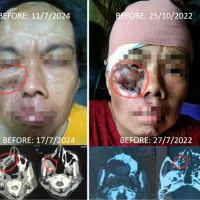
Mrs. Wini has undergone surgery 4 times since 2016, plus 25 sessions of radiation, with the last one in 2022. The tumor mass growing on the roof of her mouth (palatum) continued to grow, infiltrating her nasal cavity and cheekbone. Her cancer only stopped growing after she started using ECCT. However, it took her 2 years to finally decide to use the device because her case was considered difficult to treat with ECCT.
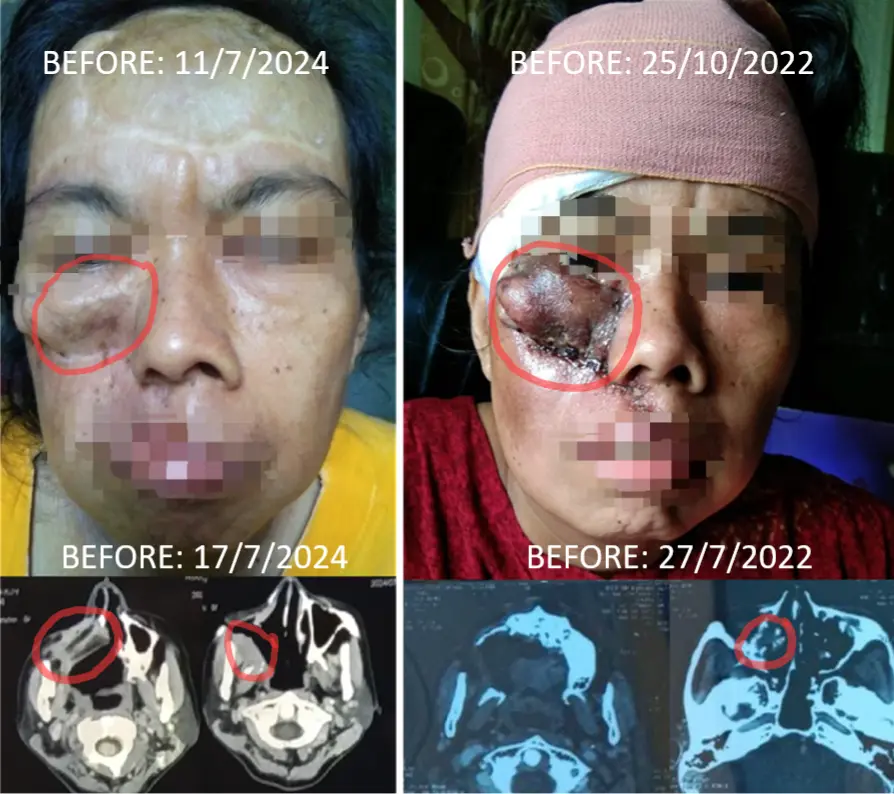
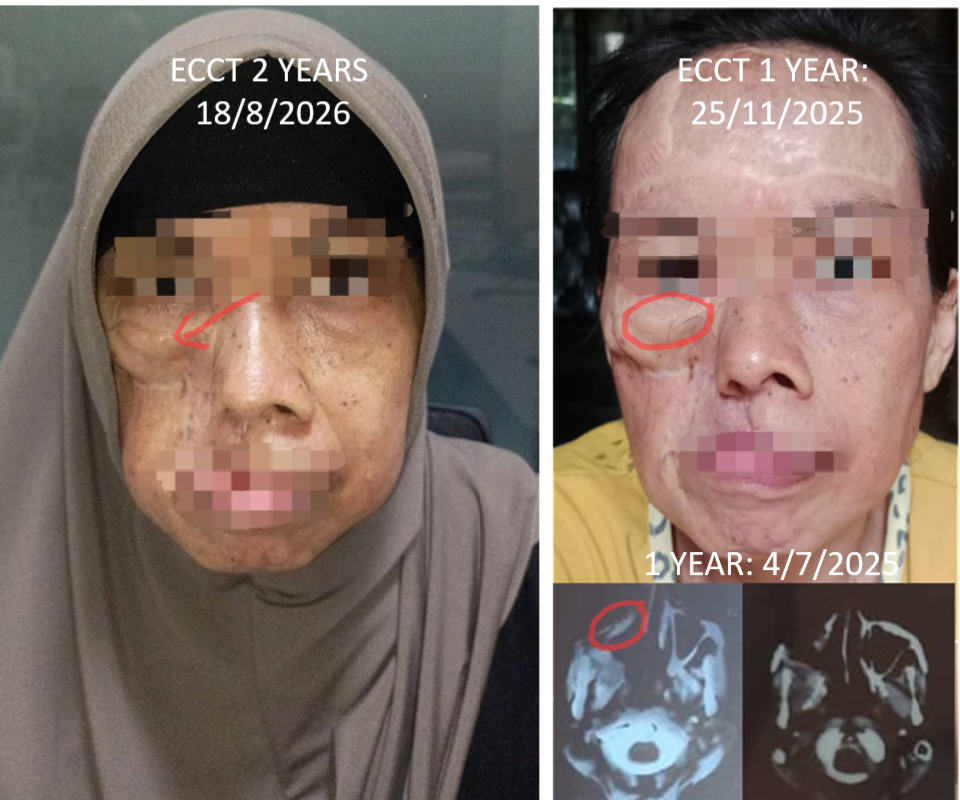
Image: TOP RIGHT: Photo of Mrs. Wini’s face after undergoing her 4th surgery to remove the tumor mass in her jaw/oral cavity and completing radiation in 2022, along with post-surgery and post-radiation CT scan results showing recurrence; LEFT: Photo of her face after 2 years without any therapy and 2024 CT scan results showing the mass had grown up to 3 times compared to 2 years prior; BOTTOM RIGHT: Photo of her face after using ECCT for a year, showing cleaner surgical scars and a brighter face, along with 2025 CT scan results showing the tumor mass had significantly shrunk; LEFT: Photo of Mrs. Wini’s face after 2 years of use, showing a relatively normal condition.
***
Pathology results showed the type was adenoid cystic carcinoma. This type is a rare cancer that generally grows in the salivary glands in the head and neck area, although it can also grow in other organs with excretion glands, such as the breasts, skin, respiratory tract, and reproductive organs. This cancer is characterized by slow growth compared to other carcinomas, invades nerves, and has a tendency to grow and spread along nerve tissue (perineural invasion), which often triggers pain or numbness. Although adenoid cystic carcinoma generally responds well to initial treatment, it has a high long-term risk of recurrence and can spread (metastasize) to other organs, especially the lungs and bones.
Because of its character of disturbing the nerves and causing continuous pain, this type of cancer can severely interfere with appearance and daily activities. Mrs. Wini experienced difficulty chewing due to the surgery to remove part of her upper right jaw and due to the pressure of the tumor mass growing back post-surgery and radiation.
She had relatively stopped doing any therapy since the end of 2022, as if she felt extremely exhausted dealing with her cancer, which kept reappearing despite numerous surgeries and radiation treatments. She had tried to look for an alternative with ECCT at the end of 2022. However, the case analysis results based on the pathology results and the latest CT scan by the ECCT biophysics team showed that her case was difficult to treat with the ECCT device. The mass growing on the roof of the oral cavity could be killed by the ECCT electric field, but the dead cells would go through a gradual shedding process like a slow surgery, which could be very painful. The second issue was that cosmetic surgical scars in the facial area could not be guaranteed to be tumor-free; if the facial skin has already been infiltrated by a tumor mass, using the device will cause malignant cells to die relatively quickly; because of their position on the skin’s surface, while many blood vessels were severed by the surgical process, the dead cells would accumulate in the tissue surrounding the tumor mass growing beneath the skin’s surface, potentially causing chronic inflammation and open wounds.
Killing malignant cells with ECCT is relatively unproblematic. The challenge arises when the tumor tissue has infiltrated and helps support the surrounding tissue; when the cancer cells shed, the surrounding tissue is also affected because its supporting tissue is sloughed off. The process of malignant cells dying and shedding can take 3-6 months, followed by a recovery process for the shed cell areas/wounds that can take more than 6 months if supported by good nutritional intake and normal immune function. The cell-shedding and recovery process can also cause pain. The recovery of shed cells in the facial area can leave scars, keloids, or facial distortions that interfere with appearance.
Mrs. Wini reconsidered her plan to use ECCT after receiving an explanation about the risks (adverse events) that could arise, so for 2 years she relatively did not undergo any therapy. Her complaints persisted. A CT scan 2 years later in 2024 showed the mass continued to grow up to 3 times its initial size after the last surgery and radiation, from 2 cm to 6 cm. For Mrs. Wini, there seemed to be no other choice but to try using the ECCT device. It took 2 years and the push of her continuously growing cancer for her to dare face the risks that could arise from using the device.
At the end of 2024, Mrs. Wini started using the ECCT device. Over the past 5 years, the ECCT research and development team has continuously strived to improve the device and its usage protocols to be more effective, reducing potential adverse events to overcome various heavy problems and challenges like the case faced by Mrs. Wini. Her case falls into the palliative category for ECCT, among ECCT users who generally already fall into the medical palliative category, using ECCT as complementary treatment post conventional care.
Over the past 5 years, the development of the ECCT device has been directed toward selecting signal modulation to eliminate inflammatory effects that can be triggered by electric field exposure on tissue, regulating the rate of cell death adapted to the body’s and surrounding tissue’s ability to absorb dead cells so that excessive accumulation of necrotic debris does not occur, which causes inflammation and open wounds. Development was also carried out to overcome the stimulating effect of the electric field on receptors on the cell membrane that act as cell growth factors, such as hormone receptors, HER2, and EGFR, so that in the long term, the device can also prevent cancer cell regrowth—a crucial aspect for slow-growing and nerve-disturbing tumor cases like the one experienced by Mrs. Wini.
Mrs. Wini’s progress was relatively good; adverse events such as chronic inflammation and open wounds, as initially explained when she first came at the end of 2022, did not occur, even though the volume of the mass had increased up to 3 times. Generally, with an increase in tumor mass volume, the likelihood of chronic inflammation and open wounds becomes higher due to the accumulation of necrotic dead cells that the body cannot absorb properly. According to the 2024 CT scan results, after 2 years without any therapy, Mrs. Wini’s tumor mass had also infiltrated the forehead, cheek, and side of the head muscles up to the upper jawbone, as well as the lymph nodes in the right and left sides of her neck. However, the unbearable pain—which is the highest risk adverse event that could occur in this case, as anticipated at the beginning—did not happen. The latest ECCT device development over the past 5 years can be said to have been quite successful in overcoming the severe challenges and problems experienced by Mrs. Wini.
During the first month of use, pain in the surgical stitches, pain in the neck where the lymph node lump was located, as well as heaviness in the head and dizziness were still present. Pain can occur because the mass has infiltrated muscle and nerve tissue. So far, the ECCT device has more or less helped reduce pain for muscle and nerve infiltration cases, but prolonged use of this feature can lead to increased tumor mass growth in the long term. Progress after one month showed that the surgical scars had completely dried up, and the roof of the oral cavity where the tumor mass had regrown appeared cleaner.
After 6 months of use, Mrs. Wini’s condition improved further, and her face looked much fresher. Sweat and urine discharge still tended to have a pungent odor, and red mucus from the nasal cavity occasionally still came out—signs that cell shedding and detoxification were still ongoing, although not as frequently as at the beginning of use. Her discharge characteristics matched the adenoid cystic carcinoma type, which tends to excrete a relatively pungent mucus fluid. While using the device, Mrs. Wini never experienced bleeding from the cancer mass area. The process of the cancer mass dissolving and shedding occurred relatively slowly without causing wounds, thanks to the latest ECCT device development. Mucus mixed with clumps continued to come out up to 1 year of use, matching its slow-growing character, because the ECCT response is directly proportional to the cell growth rate.
After a year of use, Mrs. Wini’s condition was relatively normal, her weight had increased, mucus only occasionally came out, and she no longer had sleeping problems. Pain still occasionally appeared at the surgical scar, especially after doing a lot of physical activity all day. This was likely caused by fluid accumulation due to poor flow caused by abnormal blood vessels resulting from surgical scar tissue.
CT scan results after one year of use showed that the cancer mass had shrunk by more than 90%, leaving only a thin layer of tissue on her right cheekbone.
After 2 years of using ECCT, or 10 years since she was first diagnosed with jaw/oral cavity cancer, Mrs. Wini’s condition is relatively normal, her activities are normal, and her sleep is normal.
Wishing good health to Mrs. Wini (WS).