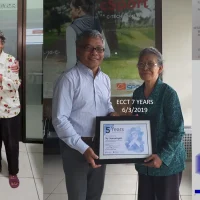
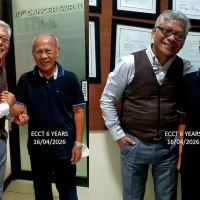
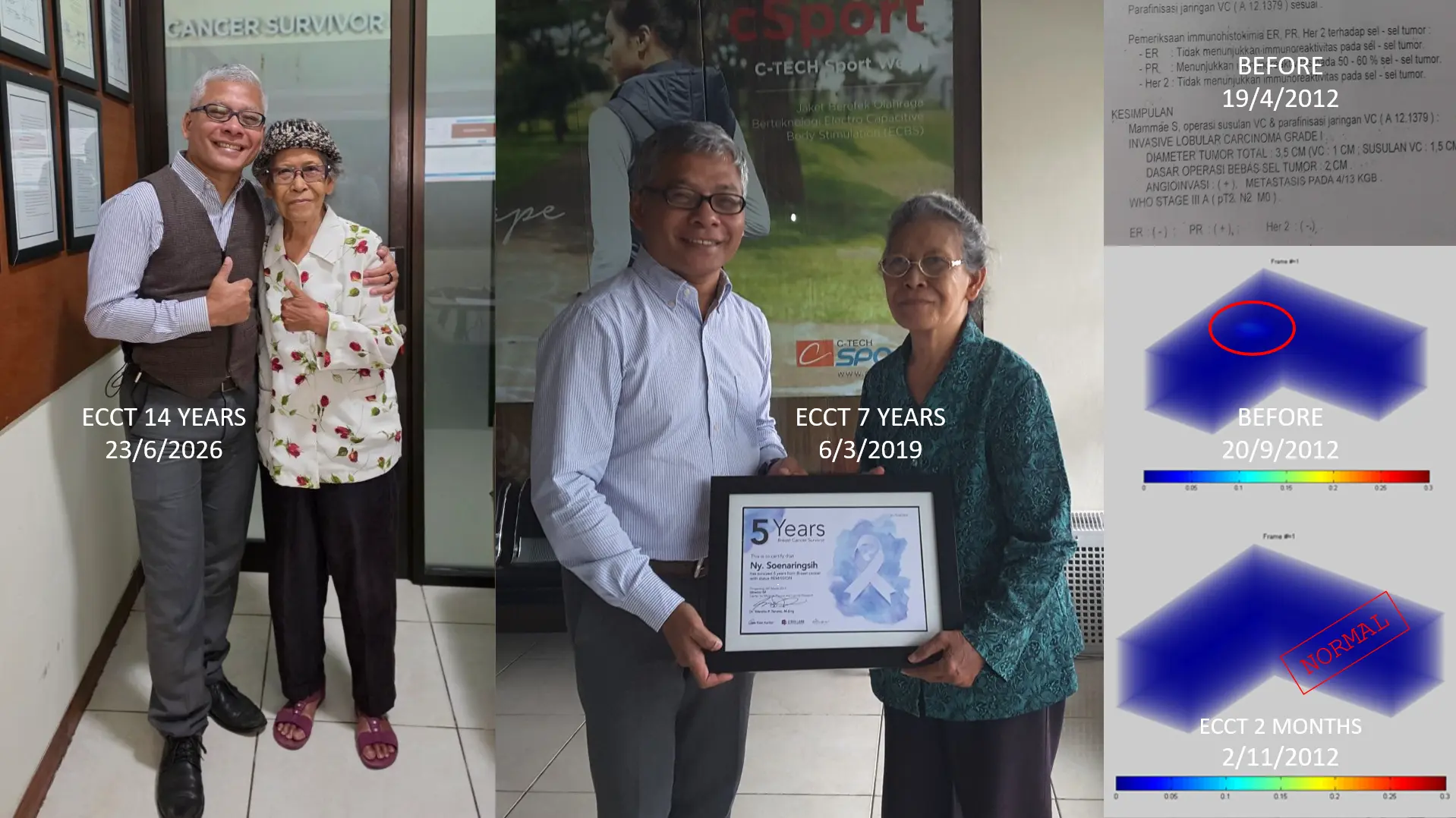
Mrs. Soenaringsih was diagnosed with stage 3 breast cancer in 2012, with invasive lobular carcinoma (ILC) grade 1 cell type, characterized by ER- PR+ and HER2- hormones. She did everything: standard therapy with surgery and chemotherapy, continued using the ECCT device while consuming hormone-lowering drugs, and has now done so for almost 14 years. Her condition is very healthy at her current age of almost 80 years; the side effects of the anti-hormone medication she has consumed for over a decade are relatively unnoticeable. The possible long-term benefits of using the ECCT device, which she uses until now, seem to smooth blood circulation, aid in waste detoxification, and prevent drug sedimentation, thus not affecting general physiological functions and body organs. Cardiomegaly (enlarged heart) and lung infiltrates that occurred initially when she was diagnosed with cancer, which generally worsen with anti-hormone drug consumption and increasing age, have now disappeared and returned to normal.
***
Standard therapy for Invasive Lobular Carcinoma (ILC) Grade 1 breast cancer with ER negative (ER-), PR positive (PR+), and HER2 negative (HER2-) characteristics, which falls into the Luminal A breast cancer group, is well-established with a relatively high efficacy rate. The 5-year survival rate ranges from 80% to 90%, and for 10 years, it is approximately 60% to 70%. However, if the tumor is larger or there has been more extensive spread to the lymph nodes (stage 3 or higher), the 5-year survival rate is in the range of 40% to 60% (droracle.ai, 2026).
For Mrs. Soenaringsih, those statistics meant nothing. She also never sought to find out what percentage chance she had of surviving cancer based on scientific evidence. What she focused on was how she could quickly be free from cancer and remain healthy, without being shackled by side effects that are often as severe as the disease itself. This likely motivated her decision to use the ECCT device.
Cancer with ER-, PR+, and HER2- hormone receptor characteristics, this subtype resembles the Luminal A type but with a negative estrogen receptor component. Anti-hormone drug therapy (endocrine therapy) remains a mainstay, but the response may differ slightly compared to tumors that are highly positive for both receptors (ER+ and PR+). Lobular Carcinoma Grade 1 of this breast cancer type typically grows slower, has a very regular cellular appearance (well-differentiated), and is less aggressive than high-grade cancers. Procedurally, surgery, chemotherapy (if indicated), and anti-hormone treatment are standard management to reduce the risk of long-term recurrence for this type.
ECCT is a non-invasive therapy developed in Indonesia that utilizes low-intensity and low-frequency static electric fields (below 30 Watts) to inhibit cancer cell division and induce programmed cell death (apoptosis). Cancer Type and Grade: Invasive Lobular Carcinoma (ILC) is known to grow slower, is typically invasive, and has specific biological characteristics. Current research indicates that cancer cells respond to ECCT depending on their polarizability. Cells with a high degree of malignancy (grade) tend to respond faster, while cells with a lower degree of malignancy or slow-dividing cells respond over a longer duration. Given its good safety profile, it can generally be said that ECCT is suitable for complementary care alongside long-term anti-hormone medication.
Mrs. Soenaringsih underwent standard therapy with surgery and chemo, as well as ongoing treatment with anti-hormone medication as advised by her doctor. She also requested an ECCT device to be made and started using it in its very early development stage. She did everything she considered logical, hoping to achieve a better survival rate, as no method guarantees 100% success scientifically and reasonably. If there were a 100% guarantee, it wouldn’t be scientific. Her husband passed away 10 years ago due to lymphatic gland cancer, just 2 weeks after surgery and while still undergoing hospital treatment. Her husband had not yet received chemotherapy or had the chance to use the ECCT device. This is likely why Mrs. Soenaringsih has not wanted to stop using the ECCT device until now, while continuously consuming the estrogen anti-hormone medication prescribed by her doctor.
At 79 years old, her condition can be described as very healthy and active. She can still travel by bus from Semarang to Jakarta and back by herself. This mother, who was actively a midwife by profession, daily leads a choir of 20 people at church and teaches music to children.
She has not experienced side effects from the anti-hormone medication she has consumed for over a decade, such as osteoporosis and fractures, joint and muscle pain, increased bad cholesterol (LDL) which triggers the risk of heart disease, as well as extreme fatigue, sleep disturbances (insomnia), hair thinning, and uncontrolled weight gain due to the long-term metabolic impact of estrogen reduction.
The long-term use of ECCT, which impacts blood circulation and the removal of accumulated waste in channels such as the digestive system and organs, likely has a positive effect, masking the side effects of estrogen-lowering drugs. Even cardiomegaly (enlarged heart) and lung infiltrates, visible from initial X-ray results when diagnosed with cancer, which generally worsen with increasing age and are compounded by the side effects of long-term anti-estrogen medication consumption, have now disappeared, and her heart and lungs have returned to normal.
She still rides her motorcycle herself for daily activities in Semarang, even to the relatively high parts of the city. She is concerned that because she will be 80 years old next year, she might no longer get a license to ride a motorcycle. Hopefully, that won’t happen, and may Mrs. Soenaringsih remain healthy (WS).