At the age of 75, 7 years ago, Mr. Benjamin was diagnosed with prostate cancer. MRI results showed a swollen prostate reaching more than 8 cm with a volume of over 200 mL, 5-7 times the normal prostate size for his age. Lesions were also found in the left prostate, already reaching 3-4 cm in size. Blood lab test results showed a PSA level of 32, 5-6 times the normal value. He had been experiencing obstructed urination and continuous bleeding. His doctor only prescribed medication to widen the urinary tract. Bleeding and obstructed urination continued for more than 1.5 years until he finally discovered ECCT. Bloody urination stopped within just 2-3 months after using ECCT, and obstructed urination also became smoother. After 6-8 months of use, his condition had relatively returned to normal. Ultrasound results showed a shrinking prostate size, a smoother prostate texture with reduced calcification levels, and lesions no longer visible after 1 year of use. PSA results also dropped to 7, close to normal. Mr. Benjamin’s latest condition (as of April 2026) appears very healthy and active, with relatively no complaints regarding his urination and prostate.
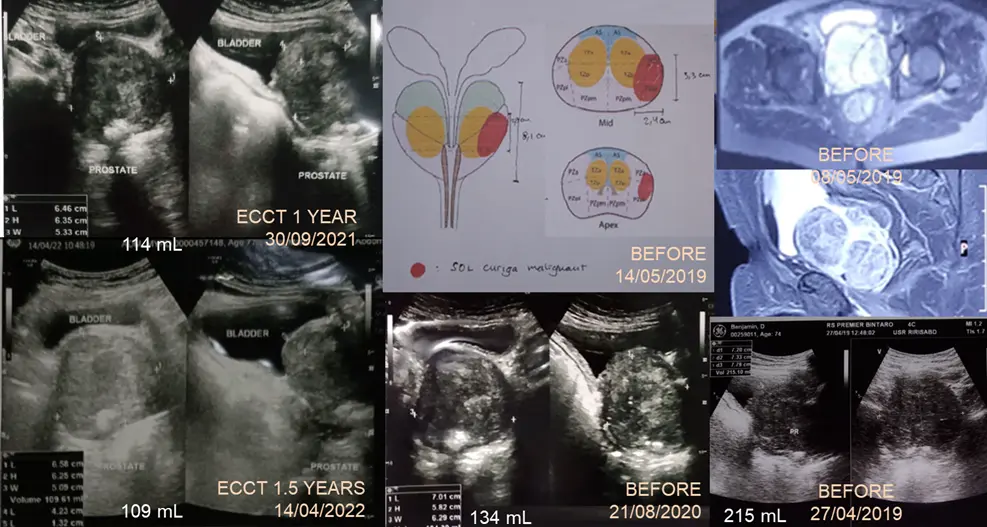

Figure 1: Top Right: Mr. Benjamin’s MRI, USG, and prostate sketch results in 2019, 2020 before using the ECCT device; Top Left: Mr. Benjamin’s prostate USG results after using the ECCT device for one year and 1.5 years, showing shrinking prostate size, smoother/homogeneous prostate texture, reduced calcification, and fading lesions; Bottom: Mr. Benjamin’s photo in 2026, 6 years (7 years since first diagnosed with prostate cancer) in a healthy and active condition.
Pak Benjamin was first diagnosed with prostate cancer in early 2019, already aged 75. Initially, he complained of bloody urination and lower back pain. MRI results showed a swollen prostate reaching more than 7.1×6.7×8.1 cm, with a volume of over 215 mL, 5-7 times the normal prostate size for his age, which ranges between 30-50 mL. MRI results also found lesions in the left prostate, already reaching 3.4×2.4×2.9 cm. Blood lab test results showed a PSA level of 32, 5-6 times the normal value, which is below 6.5 ng/mL for those over 70 years old.
He had been experiencing obstructed urination and continuous bleeding. Mr. Benjamin relatively did not undergo any therapy. His doctor only prescribed medication to widen the urinary tract. Bleeding and obstructed urination continued for more than 1.5 years when he started using ECCT.
Mr. Benjamin began using the ECCT device in late August 2020. The device he used was a pair of pants covering the prostate area up to the upper abdomen. The reactions observed included foamy and pungent urine, and sweat with a stronger odor. His bloody urination stopped within just 2-3 months after using ECCT, and obstructed urination also became smoother.
After 6-8 months of use, his condition had relatively returned to normal. Ultrasound results showed a shrinking prostate size, a smoother prostate texture with reduced calcification levels, and lesions no longer visible after 1 year of use. PSA results also dropped to 7, close to normal.
Mr. Benjamin never underwent a biopsy, so the exact cell type he experienced is unknown. Generally, over 95% of prostate cancer types are adenocarcinoma, whose aggressiveness is classified based on the Gleason Score, indicating growth and spread rate: Low Grade (Gleason Score <6): Low grade, slow-growing; Intermediate Grade (Gleason Score 7): Intermediate grade, moderate aggressive growth; High Grade (Gleason Score 8-10): High grade, cancer grows and spreads rapidly. Judging from Mr. Benjamin’s not-too-extreme excretory reactions, the tendency of the cancer cell type he experienced points towards an intermediate malignancy level (Gleason 6-7).
Generally, the higher the malignancy level (Gleason Score), the faster the response to ECCT therapy, with cells experiencing rapid death. If the removal of dead cells proceeds well, supported by a relatively normal immune system and organ function, tumor masses can approach remission within 3-6 months for the most aggressive types, and may take longer, up to 6-12 months, for types with moderate to low aggressiveness.
The prognosis for prostate cancer is generally very good, especially if detected early. The chance of recovery reaches 99% in early stages before spreading, with a 5-year relative survival rate nearing 100%. Overall, the 10-year life expectancy for patients is around 98%. Prognosis heavily depends on several determining factors, namely stage and spread: Localized cancer (not yet spread) has a very good outlook. In advanced stages (distant metastatic), the 5-year survival rate drops to about 34%. For aggressive types of prostate cancer, spread typically occurs to the bones, causing extreme pain, which is one factor contributing to the reduced survival rate.
However, the extent of spread is relatively not an obstacle with ECCT therapy. Cases that have widely spread to the bones, as in other ECCT users, can achieve remission relatively quickly (6-12 months) for highly aggressive types, as shown in Figure 2.
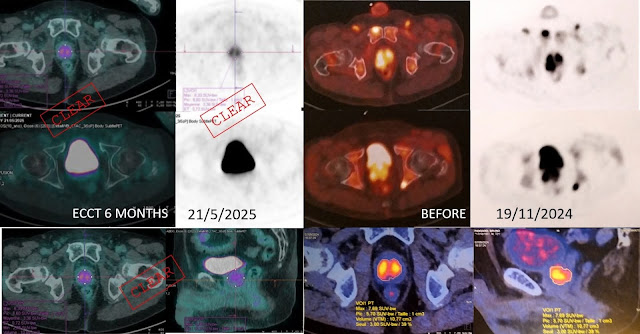
Figure 2: Another ECCT user’s prostate cancer case (Male, 72 y.o.), adenocarcinoma type prostate cancer with Gleason 9/10 malignancy level; PET scan results show cancer cells that have infiltrated the entire prostate gland, accompanied by spread to lymph nodes in the pelvic area and around the aorta blood vessels, as well as spread to points in the hip bones (stage 4);
PET scan results after 6 months of ECCT use show cancer masses that are relatively clear in the prostate and all spread points, both in lymph nodes from the pelvis to the chest and throughout the bones.
PSA values, as the primary indicator for monitoring prostate cancer progression, also generally gradually return to normal with ECCT use. Mr. Drajat’s case showed a relatively slow decrease in PSA, from 32 to 12, and then to 7 within 1.5 years and 1 year. He was not given anti-hormone medication by his doctor. For other ECCT users whose treatment was combined with anti-hormone medication, PSA levels generally decreased relatively quickly, dropping from 200 to below 1 in just 3 months (Figure 3). The combination of the ECCT device with anti-hormone medication is generally very effective in treating prostate cancer, especially for moderate-low grade types that respond relatively slowly to ECCT therapy.
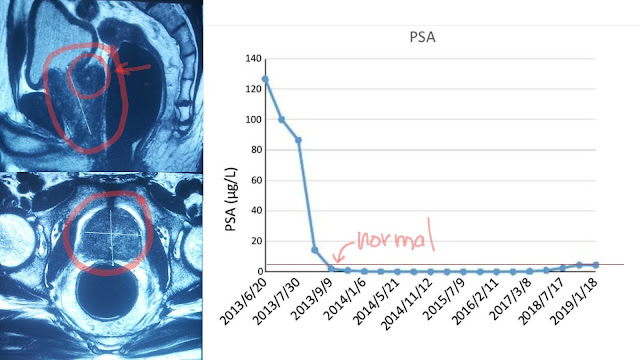
Figure 3: Case of a Male (68 years old) ECCT user for acinar type adenocarcinoma prostate cancer with Gleason 7/10 malignancy level, non-surgical due to risk of impaired urinary control function and widespread dissemination as it had entered the seminal vesicle glands; His PSA had reached over 200; His prostate enlargement had reached 2 times the normal size; He only received hormone-suppressing medication from his doctor in Singapore; His prostate swelling continued to increase from 46 cc to 78 cc; He started using the ECCT device in late July 2013; His PSA gradually decreased and returned to normal below 1 within 3 months and has remained at a normal PSA level (below 4 for ages over 70) until now; He still maintains with the ECCT device and consumes hormone medication until now; His PSA level remains at 2; At his current age, now over 80 years old, his condition is very healthy and active.
Mr. Benjamin’s latest condition (as of April 2026), 6 years of ECCT use or 7.5 years since first diagnosed with cancer, appears very healthy and active, with relatively no complaints regarding his urination and prostate. His arm muscles are very strong, and his physique is lean and athletic. At 82 years old, he relatively has no serious illnesses. He still uses ECCT for prostate prevention, as well as to maintain general health and organ function such as lungs, heart, and kidneys.
Wishing Mr. Benjamin continued good health (WS).