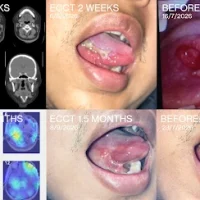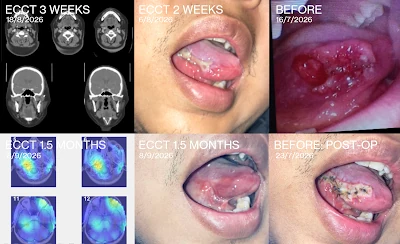
IMAGE: RIGHT: Photographs of the wound on the tongue before and after surgery, before using the device; CENTER: Photographs of the tongue after two weeks and 1.5 months of ECCT use; LEFT: CT scan images after three weeks of use and ECVT images after 1.5 months of use.
Severe stress after his mother’s death caused a wound on his tongue, originally from accidentally biting it, to turn into cancer.
At first, his tongue had merely been scratched by the sharp edge of a tooth after two neighboring teeth were extracted around February–March. Thinking it was nothing serious, Azis left it alone, only occasionally treating it with a spray. But because the scratch was quite long, the wound took a long time to heal.
Things began to change after Eid in April, following his mother’s death. The intense stress made it difficult for him to control what he ate and drank. In a single day, he could drink glass after glass of sweet beverages, more than three sachets of coffee, and eat cakes and snacks without restraint. Already obese at just 38 years old, he gained even more weight, and it became increasingly difficult to control.
The scratch on his tongue became a wet, inflamed wound, with worsening pain. The spray no longer worked. When he went to see a specialist the next day, the doctor immediately scheduled surgery.
A pathology examination of the surgical specimen confirmed malignancy: poorly differentiated, non-keratinizing squamous cell carcinoma, the most aggressive type of tongue cancer, which grows and spreads rapidly. Tumor cells were still present at several points along the surgical margins. The deep margin was very close to the tumor, with evidence suggesting lymphovascular invasion and infiltration into part of the striated muscle, along with ulceration that was already causing intense pain.
His appointment with an oncologist, following a referral from the head and neck surgeon, was still two months away under the BPJS health insurance system. While waiting for that oncology consultation, ulceration and inflammation began developing at the surgical wound within just a few days.
So, less than a week after surgery, Azis decided to seek a consultation about whether he could use ECCT.
Physically, the cancer cells of this type are soft and have a high degree of electrical polarity, unlike well-differentiated, keratinizing squamous cells, which have relatively low electrical polarity. These cells are easily affected by external electric fields and respond to ECCT. In general, the greater the malignancy, the higher the cells’ electrical polarity and the more quickly they die when exposed to the ECCT device.
Azis started using ECCT that same day. He received two sets of head coverings extending to the neck, designed to reach the primary tumor area on his tongue, along with another set covering the chest and abdomen to prevent possible spread.
The reaction was rapid, in keeping with the highly aggressive cell type: cloudy, strongly smelling urine; dark or black, strongly smelling stools; and a large amount of mucus from the tongue wound, although the mucus was relatively non-sticky. This differs from keratinizing, well-differentiated cell types, in which cell death is accompanied by very sticky mucus. Because the material from the dead cells was relatively fluid, the immune system could clear it effectively, allowing the wound to close and become clean quickly.
After two weeks of ECCT, the wound was no longer bleeding and the ulcer was considerably cleaner. A CT scan after three weeks showed only residual thickening at the surgical site on the tongue, along with enlarged lymph nodes still detectable on both sides of the tongue. There was no sign of the extensive inflammation that had been visible on his tongue after surgery.
After 1.5 months of ECCT use, the wound was clean and had healed. An ECVT scan still showed compression of the tongue nerve extending to its connection in the brainstem, near the right medulla oblongata. He also still felt aching in his tongue, which correlated with the remaining pressure on the nerve on the right side.
He had not undergone chemotherapy because he was still waiting for his oncology consultation. What is clear is that the ECCT device helped speed up healing and cleansing of the surgical wound while he waited for the oncologist to schedule chemotherapy.
Wishing Azis continued good health and a complete recovery.