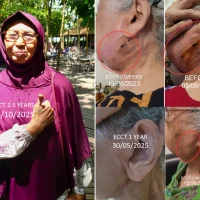
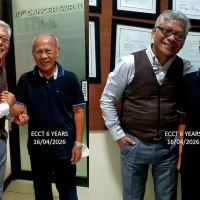
From the age of 6 years Ajie has experienced hydrocephalus, and underwent VP shunt pairs surgery up to 9 times. At the age of 21 years was diagnosed cancer in the pineal gland in the area of the mesenchepalon. Chemo and radiation have been performed, the results of post-radiation MRI examination instead of extensive spread to the pons and thalamus, causing complete blindness. After there was no other alternative Ajie then tried ECCT. Only 3 days after taking ECCT and after being blind for more than 3 months, he could see and read again. The results of MRI examination after 1 year showed a tumor mass that shrank by 80%, after 2 years shrunk again until almost gone, and declared remission after 3 years of use. Passed 13 years since the first time diagnosed with pineal cancer to experience total blindness Ajie in a healthy and independent state, although there are still complaints that the eye nerve is pulled causing squint, the possible effects of former cancer tissue that leaves scar tissue.

From childhood Ajie experienced abnormalities in the brain glands that produce brain fluid, causing hydrocephalus. Headaches and vomiting are not uncommon. The results of a CT scan he stated hydrocephalus, brain fluid that is blocked and stagnant, causing high pressure in the brain resulting in heavy head. The cause is not yet known. To overcome the blocked brain fluid Ajie underwent shunting installation surgery. But his complaints always reappeared, never completely disappeared, so he had to undergo surgery to repair or reinstall the VP shunt hose up to 9X until he graduated from elementary school.
During junior high and high school Ajie’s condition was relatively good, he completed his school well. He applied for the entrance exam for one of the favorite universities in Indonesia in Surabaya and chose a fairly difficult major: electrical engineering ITS. The exam went smoothly, but shortly after taking the college entrance exam he suddenly had a faint. He faces extraordinary anxiety like a teenager who has just graduated from high school waiting for the results of the PT entrance exam while having to worry about his health related conditions.
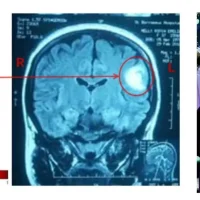
At first Ajie and her parents thought it was just a normal condition due to stress. But the results of the MRI examination showed a verdict that could be the mother’s heart stopped beating: it was known that there was a tumor attached to an area above the brain stem called the pineal. Pineal is a part of the brain that is located in the midbrain in the brain channel of the fourth ventricle above the brain stem and cerebellum. This part functions as a small endocrine gland that produces the hormone melatonin to regulate sleep cycles. Disruption of melatonin production by this gland can result in sleep disorders, cancer, depression, autism, and more.
From the results of brain MRI Ajie found tumors of less than 1 cm that tend to be malignant. For a relatively small and malignant mass, the possibility of a new mass that appears has not been too long, possibly under 3-6 months, which means that Ajie’s days are preparing for the college entrance examination. The masses that appear are not likely to cause hydrocephalus when it is elementary, but the possible cause is the same: the possibility of obstruction in the ducts of the hormonal glands.
One of the causes of brain disorders to cancer in hormone production tissue is when hormone production increases, one of which is due to stress. Coupled with the disruption of the hormone channel due to a blockage can cause the emergence of continuous inflammation to malignancy or cancer. Persistent inflammation is thought to be the cause of swelling in the pineal gland that constricts the brain fluid channel (fourth ventricle) and has an effect on hydrocephalus when Ajie was in elementary school. Inflammation continued when Ajie took the college entrance exam this time did not stop at swelling alone but ended up becoming cancer.
The size of the tumor experienced by Ajie was relatively small (early), but because of its crucial position in the center of hormones and attached to the outer brain stem, the doctor did not dare to take the risk of surgery. His doctor finally suggested giving chemo, although in his case it was already known that chemo would not restrain the rate of development of Ajie’s tumor.
The results of The its Ajie entrance exam came out, and he passed the Electrical Engineering Department. A difficult major even for a normal child, while for him it was not only a challenge to finish college but also had to wrestle with a deadly cancer in the middle of his brain.
Ajie’s next days were filled with activities between discharge and back and forth to the hospital to undergo chemo during 2011-2012. He had to be escorted by his father to pick up and go home to college.
The results of the first examination came out early 2011 after undergoing a series of chemotherapy. As expected from the beginning the tumor remains enlarged. Finally Ajie was referred to a major hospital in Jakarta to undergo radiotherapy.
He underwent a series of radiotherapies with state-of-the-art equipment in Indonesia at that time. The tumor managed to shrink after a series of radiotherapy Ajie underwent at a hospital in Jakarta. His hopes began to rise again after returning to Surabaya and following the lecture back.
But the happiness did not last long. One day Aji came back unconscious again. MRI results in Jakarta after it turned out that the tumor that had already shrunk turned out to grow back and spread to the area of the brain stem, thalamus (Brain Center) and the rear brain tissue called the visual cortex which became the center.
of AJI’s vision condition decreased, is was taken back to Surabaya without a solution.
Aji eye bags down wrinkled fatigue, as a result of his visual nerve attracted tumor mass that invaded the center of vision. His condition is deteriorating, his vision is almost dark. That’s what makes him sad, because he can’t read anymore, let alone go to college. ‘How can I go to college when I can’t read any more books,’ she said in despair.
His hope was recovered when he got a kar to be able to consult a neurosurgeon who is very famous in Tangerang. His determination to recover was very great because he wanted to be able to go to college to finish the college he had longed for since childhood. Therefore, despite having to wait up to 3 months waiting list and through a heavy journey by plane from Surabaya back to Jakarta with almost dark vision he lived, accompanied by his parents.
After a long wait at the end of 2012, the long-awaited meeting finally took place. But his doctor’s unexpected answer dashed all hope: ‘I’ve had hundreds of brain surgeries, but for this case there’s nothing more to do,’ said the neurosurgeon.
It was not just his vision that darkened his mind and his parents ‘ thoughts became dark after hearing the doctor’s answer. His father decided and booked a plane ticket back to Surabaya the next day. There is nothing to do in Jakarta anymore, he thought.
The next day on the way to Dsri Bintaro airport where to stay at your house on the advice of his brother, his mother took Ajie to stop by C-Care Cancer Research in Alam Sutera. Had experienced tremendous doubts related to the method of therapy given using a set of helmets that emit electric fields called ECCT. Especially for his father who is quite educated and very oriented in the way of medical treatment according to him is very unscientific and a waste of time. His father didn’t even want to go into the consultation.
‘We have visited all the doctors in Surabaya and Jakarta, all the existing medical equipment and technology has been used, it cannot be done. How can a place like this help?’his father was critical.
His father was even more skeptical to see the ECCT equipment given in the form of a head cover connected by a cable to the battery box. ‘It’s like a cell phone,’ he thought. But his father still let his wife pay to get the tool, and let Ajie wear it after returning to Surabaya.
Ajie’s extraordinary and unyielding desire to be able to look back and finish his college which was interrupted because he could not read anymore made him continue to try to find alternative cancer treatment in his brain. He continues to look for alternative paths that are no longer possible in modern medicine. The end of 2012 Ajie started a new struggle with the ECCT tool, after all the medical path he took.
‘It hurts crazy,’ he said when he first tried on the ECCT helmet, but he didn’t let go, because his desire to be able to see and read again was stronger. Along with the strong reaction that he felt when using the tool, the discharge reaction that came out was extreme: urine that was very pungent, the black pup smelled like a carcass, sweat and tears that were unnatural.
After 3 days from the first time wearing an ECCT electric helmet followed by a very ‘rotten’ discharge reaction, Ajie was accidentally able to read the Quran he was holding. He couldn’t believe he could read again. His father was even more surprised to see Ajie could read again and hurriedly took the Koran with large writings. ‘No need to be big, this one just looks,’ said Ajie. What makes Ajie’s father no less surprised is that such a simple tool can make his son look back in just 3 days, after almost 2 years of the most advanced medical technology and the best doctors have been unable to do anything.
3 months later Ajie came to C-Care Cancer Research in Alam Sutera for consultation. This time his father came directly and met with Dr. Warsito to get an explanation of the workings of a tool that allows his son to read and get his life expectancy back. Dr. Warsito took him around to the 2nd and 3rd floors of the C-Care Building which is a workshop and laboratory of electronics and medical physics where many students and researchers are conducting research. His father began to open that the tool’ CES-cesan hape ‘ it is the technology of the future that the effect he could see for himself on his son directly.
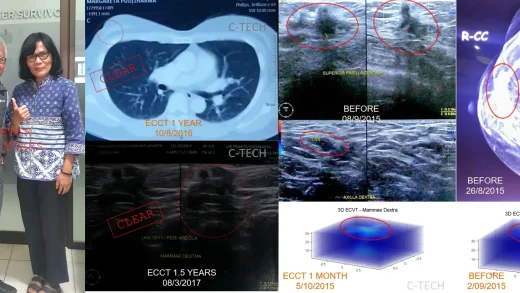
1 year later the results of an MRI of Ajie’s brain showed that her cancer had shrunk by more than 90%. Characteristically, cell types with such response rates include high-grade types such as astrocytoma or high-grade glioma. High grade glioma (HGG) is a fast-growing and aggressive tumor of the brain or spinal cord,
it is common in adults, but it can also occur in children. HGG is difficult to treat and has a low prognosis due to problems in complete removal of the tumor, easy spread to the area of nerve centers and resistance to radiotherapy and chemotherapy. With electric field therapy including ECCT generally achieve better outcomes as well as higher life expectancy.
The next year the results of MRI after pemaian 2 years showed a mass that was almost clean. Complaints such as severe headaches and weakness are no longer there. Two years after using ECCT Ajie can continue his studies at ITS. MRI 3 years after the adoption of the device he expressed remission. However, the nerves of his eyes are still there that’ pull ‘makes him’ squint ‘ so you have to wear glasses with blurred on the left eye baguan. The possible effects of radiation make some of the nerves affected because the fibrosis process becomes scar tissue.
Ramadhanu Ajie successfully graduated from its electrical engineering department in 2017, 3 years after returning to college, along with exactly 5 years he used ECCT tools.
In general, the condition is healthy and independent. He had an internship as a research assistant at an electronics company in Tangerang. He lives his own indekost. Only because he had fainted in a boarding house and was hospitalized his parents then pulled him back to Surabaya. He experienced fainting due to lack of electrolytes, possibly insecure food intake when living alone. MRI results in 2021 showed a mass that remained clean, no recurrence. Back in Surabaya, he was active in the mosque and taught to read the Quran to children-Anaj DJ his home environment.
In 2022, even 10 years since he first used the ECCT tool, he began using the electro-capacitive body stimulation (ECBS) tool for general health, helping his condition which is rather weak due to lack of movement. After regularly wearing ECBS Ajie’s condition is getting healthier, her posture is getting better, and she is starting to be able to follow long trips such as umrah to Mecca and Medina, tours to Bali and Singapore and mountaineering to Bromo or taking the bus alone round-trip Surabaya-Tangerang.
Hopefully stay healthy for Ajie (WS).