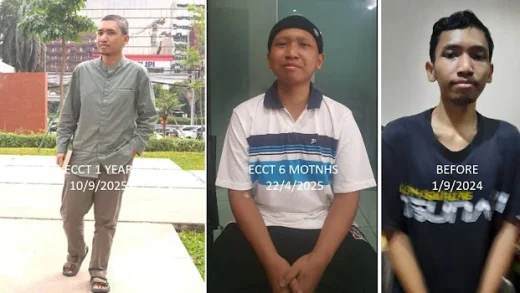
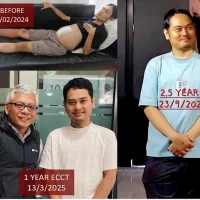
Aditya (33) overcame non-Hodgkin lymphoma affecting lymph nodes in his abdominal cavity. The cancer had encased the aorta and spread to his liver and lungs. Two and a half years ago, he was unable to get out of bed: his abdomen was swollen with fluid, his body was thin, his legs were swollen, and his weight and hemoglobin (Hb) had dropped. He returned to normal condition in less than a year while using ECCT in combination with chemotherapy. A CT scan after one year showed that the original mass had cleared, with no recurrence or metastases. He is back to work and his normal daily activities.
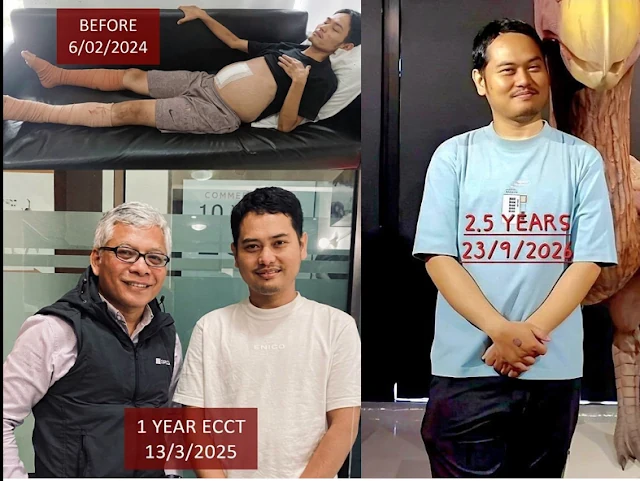
IMAGE: Top left: Aditya before using the ECCT device; bottom left: Aditya with Dr. Warsito P. Taruno after one year of using ECCT alongside chemotherapy; right: Aditya after 2.5 years of ECCT use, having completed six rounds of chemo.
Alhamdulillah, Aditya continues to be healthy and is “putting on a little weight,” as he puts it. Two and a half years ago, he couldn’t get out of bed. His abdomen was enlarged and full of fluid, his body was thin, his legs were swollen, and his weight and Hb had dropped. Cancer had filled his abdominal cavity, encased the aorta, and spread to the liver and lungs. In less than a year, he managed to return to normal.
He was first diagnosed with cancer in late 2023. A biopsy showed non-Hodgkin lymphoma, a type of cancer that develops rapidly and spreads easily because its cells are soft and can travel along the lymphatic system.
A CT scan showed a large, 11 cm mass in the abdominal cavity (para-aortic region), involving major blood vessels, with spread to lymph nodes around the pelvis and groin. The mass pressed against the right kidney and ureter, causing kidney problems and leg swelling. Multiple nodules were also visible in the liver and lower parts of the lungs; the upper lungs were not included in the images.
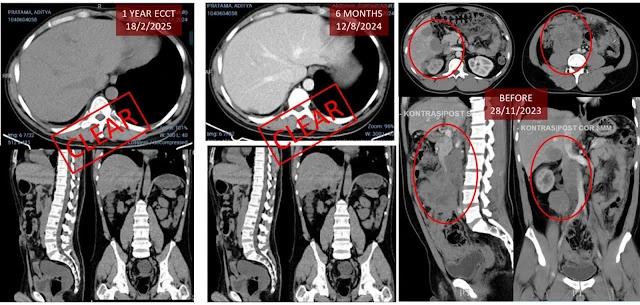
IMAGE: From right to left: The initial CT scan before ECCT, showing a large mass and nodules that had spread to the liver and lungs; center: CT scan after six months of ECCT alongside six rounds of chemotherapy; right: CT scan after one year of ECCT use, with all six rounds of chemo completed.
His cancer was already at an advanced stage. The only option was chemo. But he was so weak that he could not even sit up; he could only lie down. His wife searched for another option and sought a consultation about trying ECCT.
Non-Hodgkin lymphoma cells are characteristically soft and generally respond well to chemotherapy. However, because of their high degree of malignancy, a mass that has shrunk can grow back quickly. The softness of these cells also makes it easy for them to enter the lymphatic system and bloodstream and grow in other organs. Meanwhile, chemo is generally no longer effective once cells have spread to organs that are difficult for the blood supply to reach. Chemo also cannot be continued indefinitely because of its severe effects and burden on the body.
These cells also respond quickly to ECCT electric-field therapy, with cell death occurring within the first 15–30 minutes of use. Because the cells are soft, dead cells break down easily and can be eliminated or absorbed effectively by the body’s immune system, so the cancer mass shrinks relatively quickly.
However, the large mass and its location inside the abdominal cavity slow down the elimination process. Dead cells can only leave through the slow-flowing lymphatic system. Rapid cell death may outpace the body’s ability to clear the debris, causing chronic inflammation if large numbers of dead cells accumulate for too long. Severe inflammation can substantially worsen fluid buildup in the abdomen, or ascites.
Severe inflammation can generally be brought under control quickly with chemo. That is why, in this case, combining ECCT with chemo was still recommended, in line with his doctor’s advice. ECCT also acts as a chemosensitizer, drawing chemotherapy drugs into target areas that normal blood circulation does not reach well. Since chemo works through the bloodstream, this makes it more effective. For non-Hodgkin lymphoma, the mass generally shrinks rapidly after the first round of chemo when ECCT has already been used for one to two months.
Aditya followed the ECCT consultant’s advice, using the device for a month beginning in January 2025. He then underwent the chemotherapy that had previously been postponed: six rounds over four months, from February through June, while continuing to use the device.
His condition gradually improved while using the device alongside chemo. No inflammation developed, waste was eliminated smoothly, his abdomen slowly became less swollen, and he became more active and independent. A CT scan after six months showed that the mass had largely cleared; nodules previously seen in the liver and lungs were no longer visible.
He continued using ECCT as a preventive measure. Because these cells can readily return and spread, long-term protection to kill small numbers of cells entering the bloodstream or lymphatic system, without risking damage to organ function or the body’s overall balance, is an important key to achieving remission and recovery to a normal condition over the long term.
A CT scan after one year showed no recurrence or metastases. He was in relatively normal condition less than a year after his initial diagnosis in late 2023, and had returned to work and his usual daily activities.
As he approaches three years since his initial non-Hodgkin lymphoma diagnosis, Aditya has no complaints and no signs of recurrence or metastases. His activities are normal. Wishing Aditya continued good health. (WS)