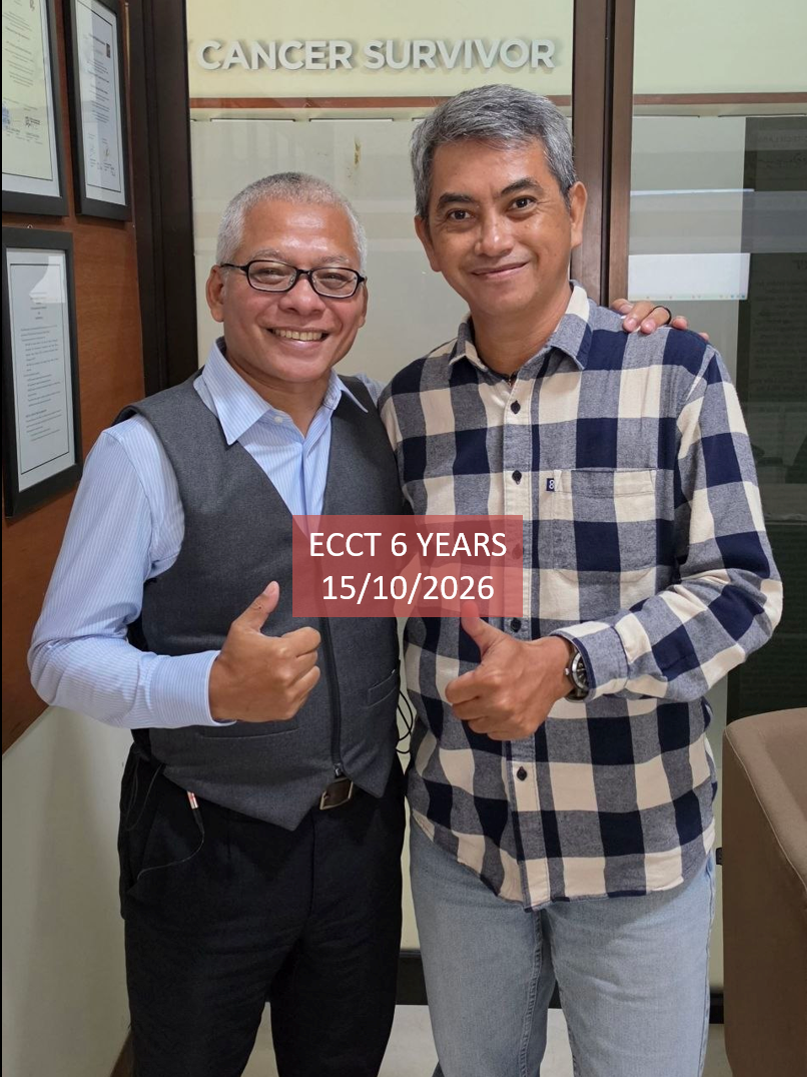
Mr. Yunanto first noticed a lump in his thyroid in late 2019. The lump grew rapidly, reaching 5 cm in the left thyroid and causing him to lose his voice in early 2020. His doctors offered surgery as the only option, with the risk that his vocal cords would be affected and his voice might never return. If the lump proved malignant, the right side of his thyroid would also have to be removed, followed by radiation, chemotherapy, and lifelong thyroid hormone replacement medication. Medically, there was no other option. He tried ECCT as an alternative. His voice returned after two weeks, and the lump disappeared after a year without leaving a trace.
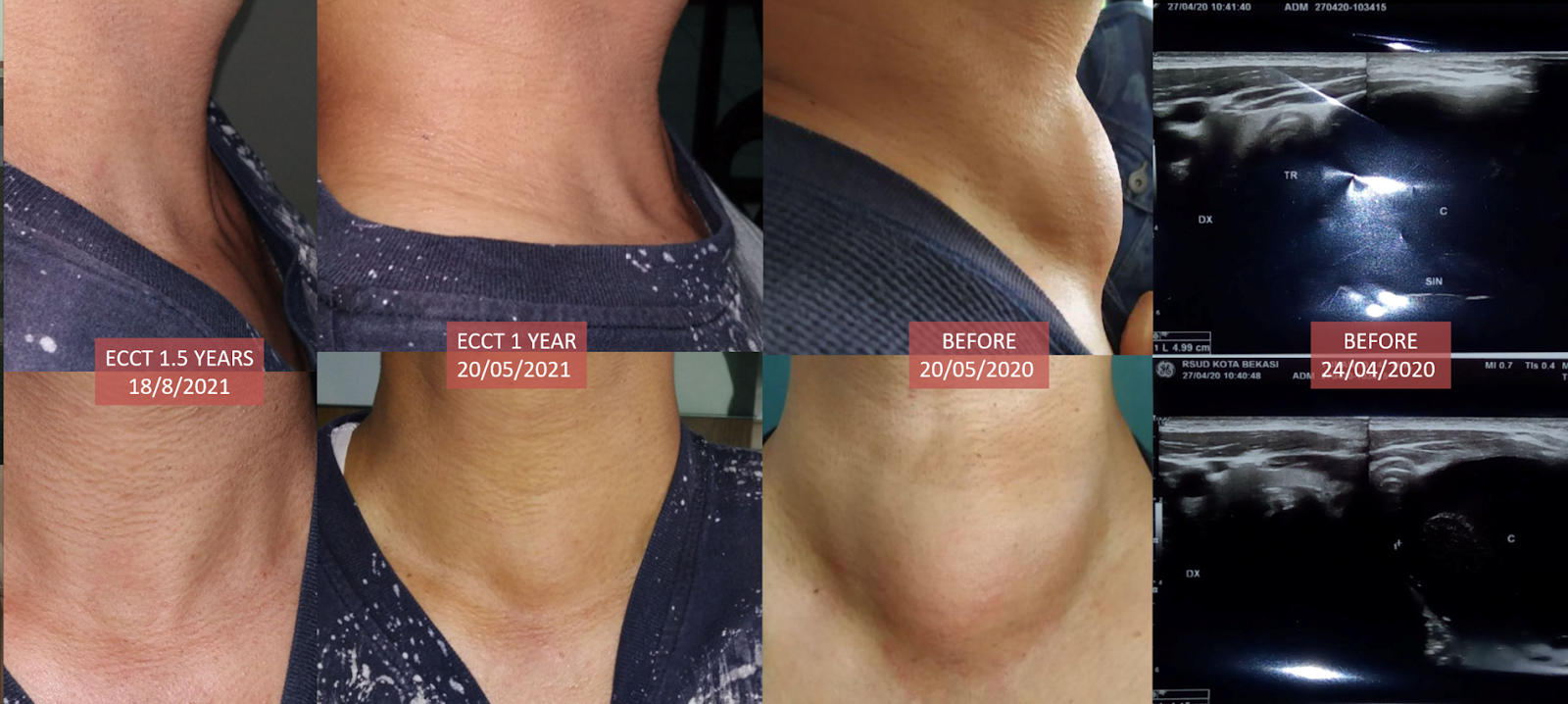
Mr. Yunanto was unable to produce a voice for months in early 2020 because of the tumor mass in his thyroid. Surgery carried the risk that his voice would never return, because the mass was very close to, or might already have been attached to, his vocal cords. None of the doctors he consulted offered an option other than surgery.
He kept searching: was there really no alternative to surgery? While he was still confused, he could hardly believe what he was told during his first consultation about using ECCT: “There is a possibility that your voice could return after 2-3 weeks.”
“Too good to be true,” he thought, quite understandably.
Mr. Yunanto first noticed the lump in late 2019. His voice was still relatively normal. But as 2020 began, the lump grew rapidly and became relatively hard, and his voice gradually disappeared as the lump in his neck enlarged. A thyroid ultrasound showed a fairly large cystic mass, reaching 5 cm in the left thyroid, with internal solid echoes. The mass had already pushed his trachea to the right.
He never underwent a biopsy, so he could not be certain whether the mass was malignant. His doctor said either was possible, and only after surgery would they know whether it was malignant or benign. If it was malignant, the right side of his thyroid would also have to be removed, followed by chemotherapy and radiation, as well as lifelong hormone replacement medication.
Whether or not his voice returned was not the main consideration. It was among the costs or risks that would have to be accepted to address a malignancy, because malignancy could have fatal consequences. This was like the often-mentioned side effect of chemotherapy that can cause hair loss: from a medical perspective, hair loss is a minor risk compared with the potential fatal consequences if a malignancy cannot be treated, because nothing is more important than avoiding a fatal outcome.
Even so, it was not easy for Mr. Yunanto to weigh which was less bearable: the loss of his voice, which might never return, or a potentially fatal outcome that he could not yet imagine actually happening.
Naturally, he was shocked and could hardly believe it. While he was struggling to decide whether to undergo surgery as his doctors advised, with the risk that his voice would never return, he was offered what sounded like a promise from heaven: a non-surgical alternative to eliminate his “cancer,” and the assurance that “his voice could return within 2-3 weeks.”
His voice really DID return after 2-3 weeks of ECCT use, specifically after 15 days of use spread across three weeks, with two rest days each week. It was an extraordinary joy, as he had been unable to produce any voice at all for months. At first his voice was still hoarse and faint; it returned to normal only after 2-3 months of use.
Mr. Yunanto never underwent a biopsy, so the cell type and its response characteristics to ECCT could not be predicted accurately at the outset from ultrasound images alone. There was only a general principle concerning ECCT responses that had been found empirically to be fairly accurate: “If the elimination process is going well, progress is generally good, and improvement may be visible within 2-3 weeks.”
To test whether that “promise” was true, Mr. Yunanto began recording in great detail each day how he used the device, what he ate, what was excreted or released, such as urine, sweat, feces, phlegm, and gas, and the changes he experienced, including his voice, starting from his very first day of using the device.
The reactions he noticed were cloudy urine with a relatively strong odor, and dark stools with a strong odor, lasting for approximately the first two weeks of use. Such reactions generally occur in cases of moderate-to-high malignancy, and do not occur in simple cyst cases using ECCT.
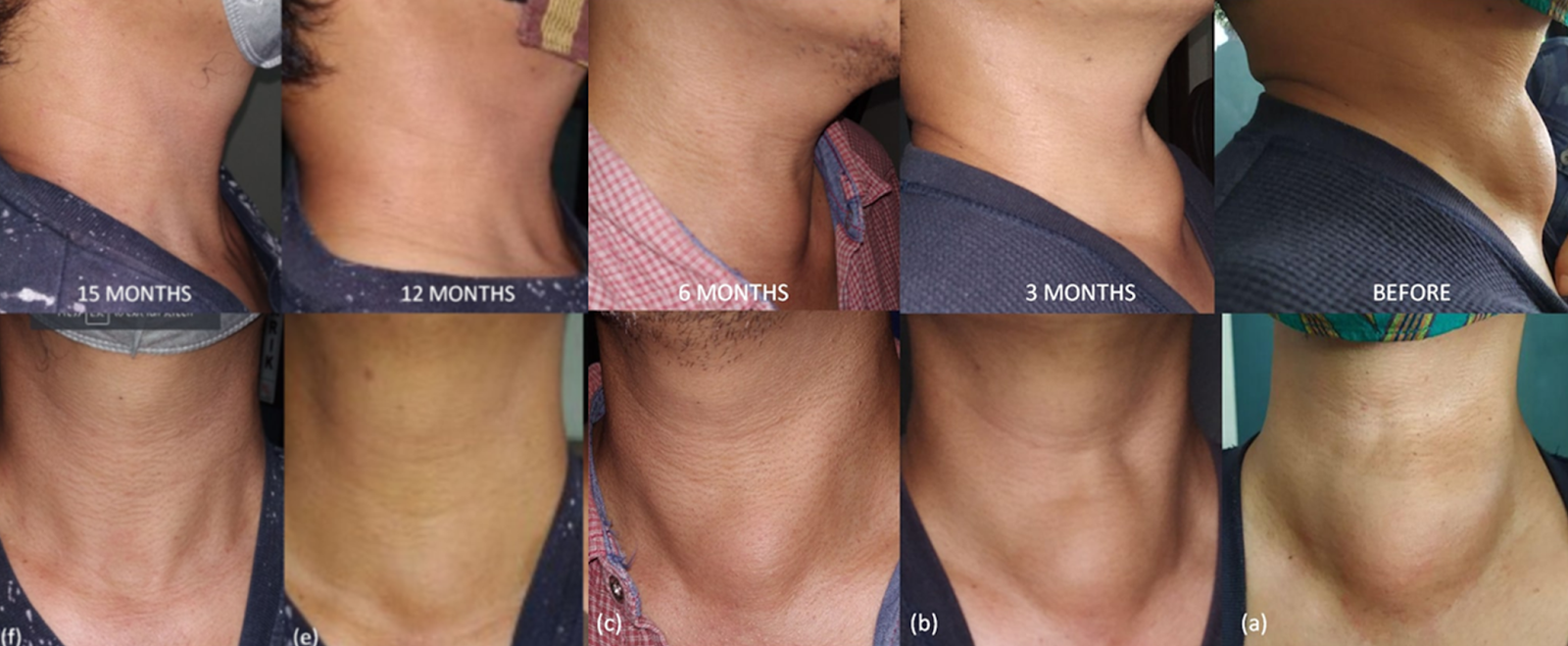
Mr. Yunanto felt that his voice returned more quickly than the lump in his neck shrank. He noticed the lump beginning to decrease in size only after 2-3 months of use. He still felt an obstruction when swallowing until three months into treatment.
After six months of use, the lump had shrunk to about 2 cm from its original size of 5 cm. After 12 months, the lump was still slightly visible, and it was only after 15 months that it completely disappeared from sight and could no longer be felt. This pattern of response was more suggestive of moderate-to-high malignancy than of a benign condition.
Throughout his use of the device, Mr. Yunanto’s general condition remained relatively normal, with no complaints related to thyroid hormone disturbances. Seven years after he first started using ECCT, his condition was normal and he remained active in everyday life. He did not need to take thyroid hormone replacement medication.
Wishing Mr. Yunanto continued good health.