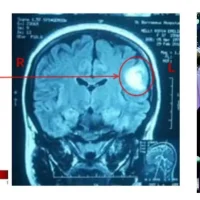
Ms. Tri Susilowati was diagnosed with breast cancer in October 2025. An ultrasound showed a mass measuring 9 × 8 cm. A CT scan showed that nearly her entire right breast had become hardened, along with signs of spread along the spine, ribs, and pelvis. A bone marrow biopsy (BMP) tested positive for cancer with an ER+, PR+, HER2- hormone-receptor profile, possibly originating from the breast. The spread to her bone marrow caused her hemoglobin (Hb) to drop to 3.7 and her platelet count to just 20,000. Despite regular transfusions throughout September–October 2025, her Hb generally remained around 8–9. Because the cancer was already at an advanced stage and her Hb stayed low, her doctor provided only palliative care, including hormone-suppressing drugs and palliative radiation. As an alternative approach, she eventually decided to try an ECCT device.
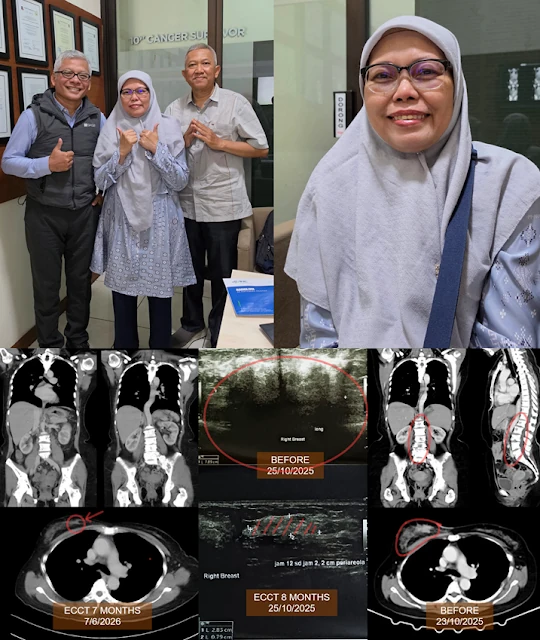
Image: TOP: Ms. Tri Susilowati looking healthy and back to normal after eight months of using the device; BOTTOM: CT scans and ultrasounds before ECCT, and CT scans and ultrasounds after seven months of use.
***
Eight months ago, Ms. Tri Susilowati’s doctor had told her to spend more time praying and focus on worship. “The cancer has spread everywhere, right into the bone marrow. The ultrasound probe can no longer reach [all of the cancer in the breast].”
By the time she was brought to the hospital, she was extremely weak. Her Hb had fallen to 3.7, and her platelet count was just 20,000. Repeated blood transfusions could not bring her Hb back to normal.
Her unmarried child could only cry after hearing the doctor’s explanation: “Mom, please don’t leave me.”
A breast ultrasound (October 2025) showed a mass measuring 9 × 8 cm; the ultrasound probe could not cover the entire lump in her right breast. A CT scan showed that almost the whole right breast had hardened, along with signs of spread along the spine, ribs, and pelvis. A bone marrow biopsy (BMP) was positive for cancer with an ER+, PR+, HER2- hormone-receptor profile, possibly reflecting spread from the breast. The spread to her bone marrow kept Ms. Tri’s Hb falling even after transfusions. Despite regular transfusions in September–October 2025, her Hb generally hovered around 8–9.
Because the cancer was at an advanced stage (stage IV) and her Hb kept falling, treatment was limited to palliative care. Her doctor prescribed hormone-suppressing medication and gave 15 sessions of palliative radiation each to the pelvic bones and the center of the chest. The purpose of palliative radiation was to ease pressure on the nerves that caused bone pain, rather than to kill and clear all the cancer cells that had spread into the bones. The mass in her breast, which had left virtually the whole right breast hard and “crumpled,” was largely left alone.
There was a bitter irony: throughout her career, Ms. Tri had worked at a specialist cancer-treatment facility in one of Jakarta’s largest hospitals. Yet her own cancer was only discovered at such an advanced stage.
Refusing to give up, Ms. Tri’s husband continued looking for alternatives and ultimately chose ECCT. She began using ECCT in late October, while continuing to take the anti-hormonal medication prescribed by her doctor. She also received bone-strengthening injections to help her bones, which had become fragile as a result of the cancer.
Her condition began to stabilize after she started using the device. During the first two months, her Hb still could not rise above 10, but it did not fall so far that she needed another transfusion. She felt fitter, her appetite improved, the lump in her right breast softened, and the retraction became less pronounced. The arm that she had initially struggled to lift could move freely again; her coughing, shortness of breath, and headaches also lessened.
After six months of use, her overall condition was relatively normal again, with Hb, platelets, and white blood cell counts also relatively normal. After six months, her bone marrow had resumed producing blood normally. Her right breast, which had initially looked “crumpled,” had returned to a relatively normal shape, almost as though nothing had happened.
An ultrasound after seven months showed that a breast mass initially measuring up to 10 cm had shrunk to under 3 cm, leaving what appeared to be a buildup of fatty tissue. This is consistent with the characteristics of Luminal A/B breast cancer cells dying and turning into cholesterol during ECCT use. Her latest CT scan showed that the spread to the bones was no longer clearly visible.
Ms. Tri is now in relatively normal condition. Wishing Ms. Tri continued good health. (WS)