In September 2024, Fauzan was diagnosed with cancer in his left lung, where the mass had already reached 18 cm. He had an almost unrelenting cough and could not sleep comfortably lying flat; he could only recline or sit partly upright. Afraid of chemotherapy, he went for an ECCT consultation with his father and mother in September 2024. The ECCT consultant explained that the cancer had grown too large. Killing the cancer cells with ECCT was not the problem, but his immune system might not be able to process all the dead cells naturally, and medical intervention would be needed to prevent an excessive immune response, such as a cytokine storm. He was therefore advised to undergo chemotherapy as his doctor had recommended while continuing to use ECCT. He used the device for three months, then began chemotherapy in January 2025, continuing ECCT alongside chemo. After three months of device use, the mass shrank from 18 cm to 16 cm. After one round of chemo, it rapidly shrank further to 7.6 cm. The tumor then shrank more slowly, from 7.6 cm to 5.7 cm over the next three months after he had completed four rounds of chemo in total. His clinical condition gradually improved as the tumor shrank. His shortness of breath and coughing had almost disappeared, and he was nearly back to his normal activities. A repeat biopsy after chemotherapy showed that the remaining mass no longer contained malignant cells; only fibrotic tissue, a remnant of the cancer, remained. He continues to use the device for prevention.
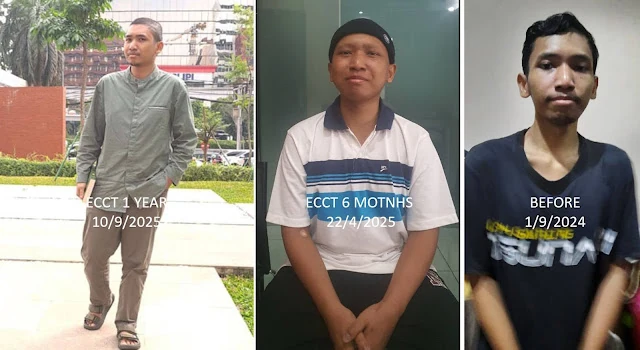
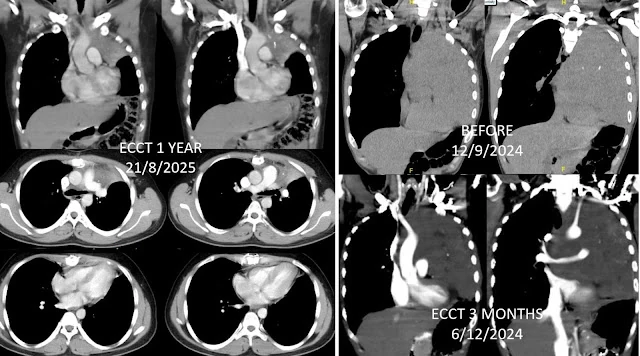
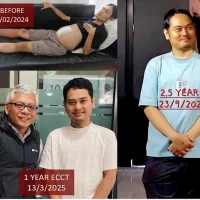
IMAGE: TOP, from right to left: Fauzan when he was first diagnosed with lung cancer, before using ECCT; after six months of use; and after one year of use. BOTTOM: CT scans before ECCT, after three months of device use, and after one year of ECCT alongside chemotherapy.
***
A year earlier, the cancer in Fauzan’s lung had already reached 18 cm. His cough was almost nonstop, preventing him from sleeping comfortably on his back. He could only lie partly reclined or sit half upright. He had lost 15 kg in six months.
He had actually undergone a bronchoscopy at a Jakarta hospital back in 2022, when a mass was found in his lung and a biopsy was recommended. Out of fear, he did not continue treatment, and his doctor did not give him any medication. Three years later, his condition had deteriorated further. A CT scan showed that the tumor had filled his left lung, pushing his heart, airway, and esophagus toward the right lung. Lesions indicating spread were already present in the right lung and liver. A biopsy confirmed a malignant mixed germ cell tumor. A bone scan also showed spread to his skull. His cancer was already at an advanced stage.
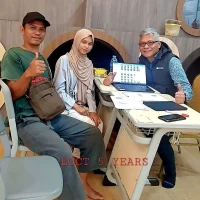
Afraid of chemotherapy, Fauzan came with his father and mother for a consultation in September 2024 about the possibility of ECCT therapy. The ECCT consultant explained that the cancer was already too large. Killing the cancer cells with ECCT was not the issue, but his immune system might be unable to process all the dead cells naturally, so medical intervention was necessary to avoid an excessive immune response, such as a cytokine storm. He was therefore advised to undergo chemotherapy as recommended by his doctor while also using the ECCT device.
Using ECCT before chemo helps kill as many malignant cells as possible and weaken the cancer overall. Chemotherapy after two to three months of device use generally works quickly to suppress the immune response so that severe inflammation does not occur, and the mass usually shrinks rapidly after just one round of chemo. This is consistent with clinical trial results showing that combining the device with chemo produces an average tumor-volume reduction of up to 74% within two to three months, compared with an average reduction of only 45% with chemo alone.
How much a tumor mass shrinks with the device alone depends greatly on how the cancer cells break down and how the dead cells are eliminated. In cancers with soft, highly malignant cells, such as poorly differentiated or undifferentiated adenocarcinoma, the breakdown of tumor cells is relatively rapid—within weeks. If elimination pathways function smoothly, the tumor can generally shrink by 70–80% in one to three months.
The challenge in Fauzan’s case was that his cancer cells were physically relatively tough and the tumor’s location in the lung made elimination less efficient. As a result, dead cells could accumulate in large quantities and cause severe inflammation. Combining ECCT with chemotherapy would prevent chronic inflammation and speed up the shrinkage of the tumor mass.
Fauzan started using ECCT in mid-October 2024. Progress was slow, with little clinical improvement during the first two months. His cough had not changed much, he still could not sleep comfortably lying flat, and he continued to lose weight. The signs of waste elimination were also relatively normal, as initially expected.
However, a CT scan after two months showed that the tumor had shrunk from 18 cm to under 16 cm. The metastatic mass in his liver was no longer detectable, the lesion in his right lung was stable, and no new metastatic lesions had appeared. The mass was smaller and the spread appeared to have cleared to some extent, but the tumor was still relatively large. His clinical improvement therefore remained slow, as dead cells were still accumulating. He was again advised to proceed with chemotherapy, as his doctor had recommended from the beginning, to speed up treatment.
Fauzan began chemotherapy in January 2025, three months after starting the device. He continued using ECCT alongside chemo. The combination of ECCT and chemotherapy has what is known as a chemosensitizing effect, increasing sensitivity to chemo because the electric field draws blood cells carrying chemotherapy drugs toward tissue surfaces that the smallest blood vessels cannot reach effectively.
In Fauzan’s case, chemo combined with ECCT resulted in significant tumor shrinkage. After one round of chemotherapy while continuing to use the device, a CT scan showed that the mass had shrunk from 16 cm to 7.6 cm. The tumor then shrank more slowly, from 7.6 cm to 5.7 cm over the following three months, after he had completed four rounds of chemo in total. His condition gradually improved in line with the shrinking tumor. His shortness of breath and coughing had largely disappeared, and he had almost resumed normal activities. A repeat biopsy after chemotherapy showed that the remaining mass contained no malignant cells, only fibrotic tissue left behind by the cancer.
Fauzan continues using ECCT for prevention. One year after first using the device, his condition had returned to normal. His weight rose from 46 kg to 65 kg in three months, more than making up for the weight he had lost before starting the device. He returned to work after being away for a year. The fibrotic tissue in his left lung remained relatively unchanged in size on the CT scan taken after one year. Wishing Fauzan continued good health.