A year ago, Erwin could not open his right eye because of nasopharyngeal cancer. A CT scan of his head and neck showed a mass in the right nasopharynx that had extended into the left nasopharynx and spread into the intracranial cavity. A biopsy identified a malignant, undifferentiated, non-keratinizing squamous cell carcinoma, a highly aggressive type of cancer. Cases like his are generally classified as advanced-stage disease (IVA/IVB). At this stage, medical care and treatment generally shift toward palliative therapy to control symptoms, improve quality of life, and extend survival; achieving a complete cure is difficult. Yet Erwin managed to overcome those formidable challenges, become free of the disease, and return to normal.

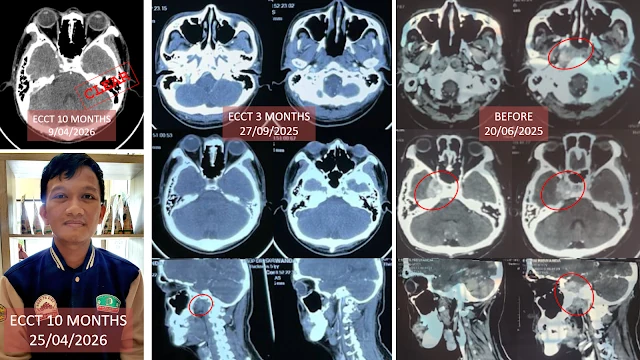
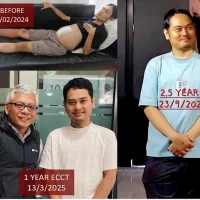
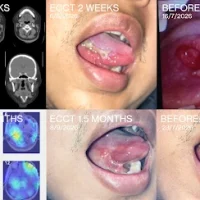
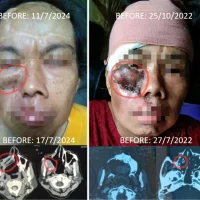
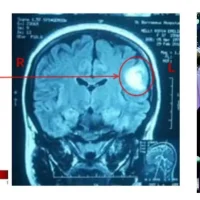
IMAGE: TOP: Photos of Erwin before ECCT, after three months, and after ten months of use. During the first three months, he also received three rounds of chemotherapy and 16 of 33 planned radiation sessions, stopping radiation because his condition became too weak. BOTTOM: Far right: Initial head and neck CT scan showing a right nasopharyngeal mass extending leftward and into the intracranial cavity; center: CT scan after three months of ECCT alongside chemo and radiation, showing significant shrinkage and clearing of the intracranial spread; far left: CT scan after ten months, showing that the mass had cleared.
***
A year ago, Erwin thought he might never be able to open his right eye again because his nasopharyngeal cancer had spread to the brain. But he found a way to see normally again.
Erwin was diagnosed with nasopharyngeal cancer around the middle of 2025. A head and neck CT scan showed a mass in the right nasopharynx extending into the left nasopharynx, the pharyngeal and parapharyngeal spaces, the prevertebral space, and the intracranial cavity at the extra-axial cavernous region. This affected the nerves controlling his eye, leaving him unable to open his right eyelid or move the pupil. A biopsy identified a malignant, undifferentiated, non-keratinizing squamous cell carcinoma, a highly aggressive type.
Initially, vision in his right eye became blurry and the eyelid began to droop. Gradually, he became unable to open it at all. He could no longer move his pupil to the right or left. His appetite decreased, and he lost as much as 15 kg over two months. At times, he coughed up phlegm mixed with blood.
After the biopsy results came back, his doctor advised him to proceed with chemotherapy and radiation. But Erwin was worried about the side effects and the small chance of complete recovery, given how advanced the cancer was. In general, intracranial spread in nasopharyngeal carcinoma is classified as advanced-stage disease (IVA/IVB). Spread into the intracranial cavity, or brain, means the cancer has penetrated the structures or bones at the base of the skull and reached brain tissue or the cranial nerves. At this stage, medical treatment usually shifts toward palliative care to control symptoms, improve the patient’s quality of life, and extend survival, while a complete cure becomes difficult to achieve.
He kept searching for another option that might offer a better chance of recovery and eventually sought a consultation about using ECCT. The ECCT consultant explained that, in general, highly malignant cell types like his respond well to ECCT: the cells die quickly and, being relatively soft, can be eliminated through the body’s excretory processes. However, because the mass was already extensive and had spread toward the brain, his immune system would probably have a heavy burden processing accumulated dead cells. The consultant therefore recommended combining ECCT with the medical procedures advised by his doctor, such as chemo and/or radiation.
Erwin felt hopeful again and decided to use the device while continuing chemotherapy and radiation.
Undifferentiated, non-keratinizing squamous cell carcinoma is the most aggressive type of nasopharyngeal cancer. It can spread easily to surrounding tissue and other organs. Yet because its cells are softer than well-differentiated or keratinizing types, it responds more quickly to ECCT. The cells die faster, turning into mucus that can flow into the respiratory tract or leave through other excretory pathways. The cells generally break down and the mass shrinks within two to three months of use. Combining ECCT with chemo can speed up therapy, preventing inflammation from accumulated dead cells and helping the tumor shrink faster, based on the results of a 2019 clinical study.
Erwin started using ECCT in late June 2025. One device was a newly designed helmet covering his head, neck, chest, and upper abdomen. He also used a second set consisting of a smaller helmet covering his head and neck, combined with a vest covering his chest. He continued the chemotherapy prescribed by his doctor for three rounds, followed by radiation, of which 33 sessions had been planned. But after only 16 sessions, he stopped radiation because his condition had deteriorated. From that point on, he continued using ECCT alone.
The reactions to using the device included the usual excretions: dark, strongly smelling stools; almost continuous passing of gas; and strong-smelling sweat and urine. There was also a continuous flow of mucus from his mouth, sometimes accompanied by lumps of solid tissue. As the waste was eliminated, his headaches eased, and pain and numbness in his right cheek diminished. His right eyelid, which he previously could not open at all, began to lift, and he could move his pupil again. After three months, he was able to see with both eyes once more.
A CT scan after three months of ECCT, including the initial three rounds of chemo and about half of the 33 planned radiation sessions, showed that the mass had shrunk from 3.5 × 3.2 × 5.5 cm to 1.7 × 2.2 × 2.3 cm, a reduction of approximately 60% by volume. The intracranial spread had cleared, and spread to lymph nodes on both sides was no longer visible. Another CT scan after nine months of ECCT, following the discontinuation of radiation because of his weakened condition, showed that the mass had cleared. There was no sign of spread to lymph nodes or other organs, except for some residual thickening at the original tumor site in the right nasopharynx.
This shows that suboptimal doses of chemotherapy and radiation combined with ECCT can still achieve remission and support a good quality of life in aggressive nasopharyngeal cancer cases like Erwin’s. Other clinical studies have also shown that combining electric-field therapy with treatment in the United States can improve treatment effectiveness while reducing side effects and improving patients’ quality of life. A clinical study conducted by Prof. Romdhoni (2019), presented at the 18th ASEAN ORL-HNS Congress, reported an average tumor-volume reduction of 74% with combined treatment, compared with 45% with chemotherapy alone.
Based on laboratory and clinical research, electric fields do more than merely “add” an effect: they multiply the effectiveness of chemotherapy through three mechanisms: (1) increasing drug uptake (chemosensitization), (2) opening the blood-brain barrier, and (3) a dual antimitotic effect.
Research available through PubMed Central (PMC) demonstrates that exposure to electric fields modifies cellular transport proteins, increasing the concentration of chemotherapy drugs entering cancer cells by more than 70%. This is what makes low-dose chemotherapy much more effective. In cases where cancer has spread to the brain, electric fields can temporarily increase the permeability of blood vessels in the brain, allowing chemotherapy drugs that would normally struggle to cross into the brain to enter at an optimal dose. A dual antimitotic effect can also occur: chemotherapy chemically attacks the phases of cell division, while electric fields disrupt the cells’ physical structures (tubulin and septin) as they divide.
Erwin has now returned to normal and is active again. His weight is still somewhat lower, possibly because he is dieting and reducing his calorie intake, but overall he has relatively few complaints. Wishing Erwin continued good health. (WS)