One and a half years ago, Ms. Jumariati was coughing up blood because her ovarian cancer had spread to her lungs, accompanied by massive pleural effusion. Her cancer continued to grow despite five rounds of chemo during the preceding four months. Within less than six months, the diameter of a metastatic mass in her lungs had more than doubled. The cancer had features of a highly aggressive type (high grade), namely high-grade serous cell carcinoma. Her ovarian cancer could not be operated on because it had spread to the lungs, leaving chemo as the only medical treatment option. But chemo was no longer working either. At that point, ECCT was the only option she had left.
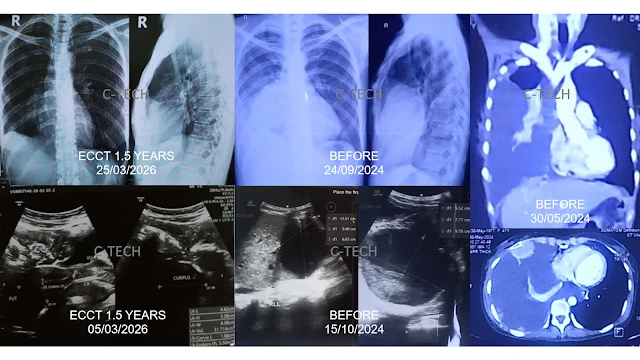
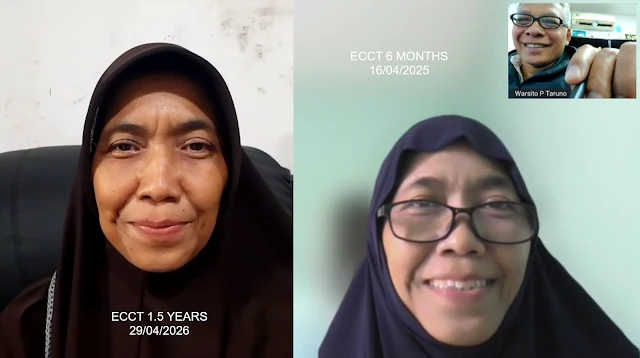
Images: TOP: Initial ultrasound and CT scan results before and after chemo, but before starting ECCT, showing a mass in the uterus and spread to the lungs with massive pleural effusion. The lung mass grew rapidly within three months despite chemo (X-ray dated 24 September 2026). X-rays after 1.5 years of ECCT show the lung mass no longer clearly visible and the pleural effusion cleared, while an abdominal ultrasound shows that the mass in the uterus is no longer clearly defined. BOTTOM: Photos of Ms. Jumariati after six months and 1.5 years of use, looking healthy and relatively normal.
***
One and a half years ago, Ms. Jumariati was coughing up blood because ovarian cancer had spread to her lungs. Her abdomen had also become swollen due to fluid in the abdominal cavity (ascites), alongside massive pleural effusion in the lungs. She had already undergone chemotherapy. Following chemo and the insertion of a drainage tube, the ascites decreased and her abdomen became less distended.
Her cancer continued growing despite five rounds of chemo during the previous four months. In less than six months, the ovarian mass grew from just 6–7 cm to 14 cm, while masses in the lungs grew from 2–3 cm to 5–6 cm—more than doubling in diameter. The cancer had high-grade characteristics, and a subsequent biopsy confirmed high-grade serous cell carcinoma.
Ms. Jumariati’s cancer could not be operated on because it had spread to her lungs. Chemo was the only medical treatment option, yet the chemo was no longer working. At that time, ECCT was the only option left for her.
However, the ECCT therapy consultant explained that, for the highly aggressive cell type, there was a possibility that the masses in the lungs could shrink or even disappear. The ovarian mass, on the other hand, might only be rendered nonviable rather than expelled because it was enclosed within a membrane.
ECCT cannot destroy that membrane, which is essentially normal tissue recruited by the tumor (tumor-associated fibroblasts); only the malignant cells can be destroyed by ECCT. That is also why chemo had not worked: drugs injected into blood vessels could not penetrate the tumor membrane. Likewise, the tumor mass killed by ECCT would not be able to pass through the membrane and leave the body, so it would not disappear unless removed surgically. Surgery, meanwhile, would only be possible once the spread in the lungs had cleared.
For Ms. Jumariati, that was probably the best outcome she could hope for in her circumstances. Whatever procedure might be required later, the first task was to kill the malignant cells.
In principle, ECCT was considered capable of killing malignant cells in the abdominal cavity because its electric field could still penetrate the body’s complex tissues. Its effectiveness, however, could diminish in the presence of ascites: fluid in the abdominal cavity reduces the dielectric contrast between tissues and makes the electric-field-strength gradient less steep. Draining the ascitic fluid would help maintain the effectiveness of electric-field therapy for cancers in the abdomen.
Ms. Jumariati began using ECCT in late 2024. Her condition gradually improved as she used the device. Her appetite returned, while the coughing and shortness of breath gradually eased. She stopped coughing up blood within two weeks of starting to use it.
Large amounts of white, sometimes thick yellowish sputum came out as a reaction to cancer cells breaking down in her lungs. Ms. Jumariati also eliminated dead cells through frequent, almost continuous passing of gas; clear, foamy urine without a pungent smell, passed almost hourly during the first two to three months; and other bodily discharges. She did not experience mucus resembling vaginal discharge, menstrual-like clumps, or extremely foul-smelling black stools, consistent with the mass being enclosed by a membrane.
Early in the course of use, she developed a fever resembling a viral infection. This is a normal immune response to dead cells beginning to circulate in the blood, generally starting around the third week. This shows that cell death can occur within weeks. In theory, cell death can occur within two to five minutes; direct observation of cancer tissue in patients with adenocarcinoma showed cell death within 15–30 minutes.
Her general condition also improved relatively quickly. Within less than three months, she was back to her routine duties as a homemaker, including mopping floors, cooking daily meals, and preparing large quantities of food each week for the Jumat Berkah charity activity. In less than six months, she had returned to teaching in person on campus.
Possibly because she was overexerting herself physically, her condition deteriorated again and massive ascites reappeared in her abdomen. Fluid had to be drained from her abdomen on three occasions, totaling 8.5 liters. This can happen when a tumor mass in the ovary has become dead or weakened but cannot be expelled. Excessive physical activity may lower blood albumin and electrolyte levels, potentially triggering chronic inflammation as an immune response to dead cells that remain in the body.
Fortunately, the lung masses had almost completely cleared and the pleural effusion had not returned. Her doctor therefore felt able to proceed with surgery to remove the ovarian tumor. Ms. Jumariati underwent three rounds of chemo before the operation and three more afterward. The ovarian tumor could be completely removed without adhesions. Using the device for two to three months before surgery generally helps loosen adhesions in ovarian cancer cases so the tumor can be removed cleanly. She continued using the device to prevent recurrence and further spread, as well as for general health.
The surgical findings confirmed high-grade serous cell carcinoma, a highly aggressive type of ovarian cancer. High-grade serous cell carcinoma (HGSC) that has metastasized to the lungs can cause massive pleural effusion and ascites, indicating advanced cancer (stage IVB) and highly aggressive tumor behavior. Such cases are generally treated palliatively, focusing on symptom relief—for example, fluid drainage (thoracentesis for the lungs and paracentesis for the abdomen) to ease breathing and pain. The prognosis is generally poor, with average survival of only 7–23 months; achieving remission and regaining a healthy, cancer-free condition is almost impossible.
Yet Ms. Jumariati managed to turn her situation around, moving from palliative to curative treatment, becoming free of cancer, and returning to a normal condition.
In general, cancer spread is not necessarily an obstacle for ECCT. Cancer cells can still be killed; the more aggressive the cells, the faster they can be killed. If dead cells can be eliminated smoothly—depending on both the cell type and the routes of elimination—even widespread, soft, aggressive cancers such as poorly differentiated adenocarcinoma or high-grade serous cell carcinoma may still clear. A tumor mass that cannot be eliminated after its cells have been weakened or killed may be removed surgically once the spread has cleared. It generally takes two to three months of ECCT to weaken or kill highly aggressive ovarian cancer cells before surgery, and six months to clear smaller metastatic deposits so surgery becomes possible. Chemo helps prevent chronic inflammation when cancer has spread to lymph nodes, potentially allowing remission to be achieved faster.
Ms. Jumariati is now healthy and carrying out her normal activities, more than 1.5 years after first using ECCT and two years after being diagnosed with stage IVB ovarian cancer.
Wishing Ms. Jumariati continued good health. (WS)