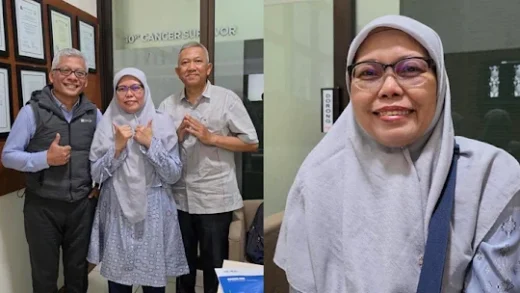
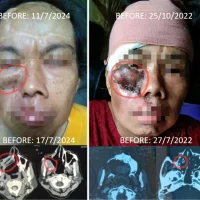
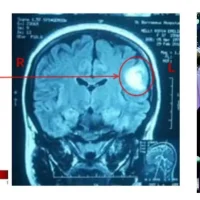
The first ECCT user, a stage-four breast cancer survivor, has reached 15 years in good health, free from cancer and other illnesses without chemo.
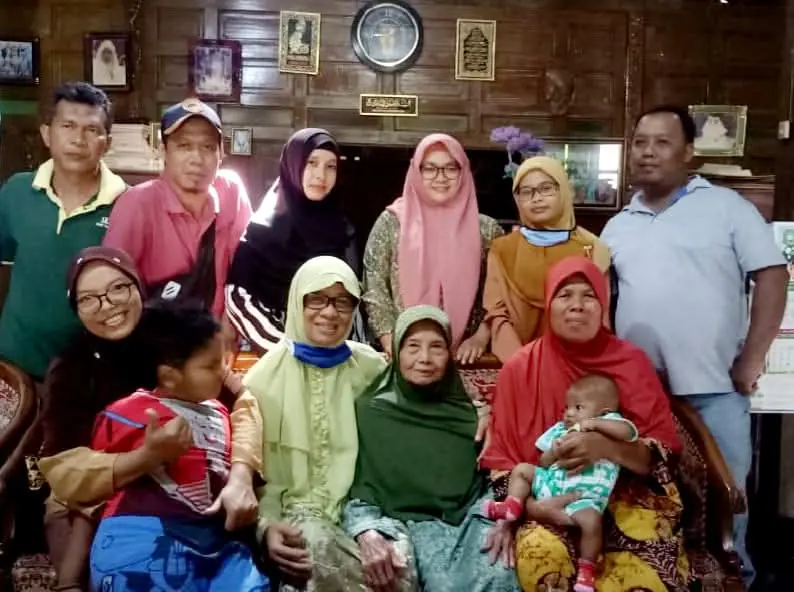
YU WARNI IS DOING JUST FINE
By Fenty Effendy
(This piece is republished from Fenty Effendy’s book “Setrum Warsito,” with the author’s permission, and reformatted for posting on social media.)
One day in March 2010, Warsito approached Yanto and his colleagues. He was carrying several bras and asked them to create an electric field inside them.
That meant taking the women’s undergarments apart to make room for electrode plates.
Rohmadi, in particular, was tasked with preparing an electric-wave generator (oscillator) with a specified voltage. This device would enable the electrode array to produce a static electric field.
Yanto admitted they had to try very hard not to laugh. Until then, they had tinkered with iron, pipes, and gas cylinders—work that felt “very manly.” Suddenly, they were handling lace-trimmed fabric: women’s underwear.
Suppressing their laughter, they opened up the bra’s lining so they could insert several electrode plates connected by thin wires. Then they sewed it back together.
“We weren’t allowed to laugh, and we couldn’t laugh, because the boss himself was the one asking us to do it,” Yanto said.
When they finished, Warsito raised his eyebrows at their handiwork: “Why is this so untidy?”
Yanto and his friends had to redo what had seemed like a silly assignment. They rearranged the electrode plates and fixed the messy hand stitching. Once Warsito finally approved the work, none of them dared ask what the modified bra was for.
“Maybe it’s a rat-repelling device,” Rohmadi joked to his friends.
They burst out laughing.
Weeks passed, and the commotion over sewing bras faded from memory. Yanto, Rohmadi, and their colleagues returned to their usual work.
Only in August 2010 did Warsito tell Rohmadi that the bra fitted with electrodes was for Suwarni, his older sister, who had stage-four breast cancer. After two months of continuous use, blood tests, ultrasound, and chest X-rays showed that the cancer was no longer detectable.
The graduate of Electrical Engineering at Semarang State University recalled, “I never imagined when I was in college that one day I would be able to heal someone.”
“I had actually passed the civil-service entrance exam. My mother and father wanted me to become a civil servant so I’d have a pension when I got old.”
“But I was more interested in ECVT, and they were disappointed by my decision. So when I heard the news, I wasn’t just happy—I was moved!”
* * *
For Suwarni, stage-four cancer struck like lightning. A week after being diagnosed with the life-threatening illness, she underwent surgery to remove her left breast and a three-centimeter lump in her armpit, to prevent cancer cells from spreading to other parts of her body.
This mother of three thought the problem was over once the operation was done. But although her breast had been removed, cancer cells remained along the incision and had even begun to affect her lymph nodes. The doctor told her there was no option but chemotherapy.
“I asked, ‘If I have chemo, does that guarantee the cancer won’t come back?’”
“They answered, ‘There’s no guarantee, Ma’am.’”
“I asked again, ‘What if I don’t want chemo, Doctor?’”
“‘Well… you probably only have another year or two to live,’ they said.”
“Back then, one chemo session cost 30 million rupiah. For my condition, they estimated I would need nine rounds.”
“I thought to myself, how could I spend that much money without even a guarantee I’d recover?”
Her husband, Supardjo, supported his wife undergoing chemotherapy. If they had to sell their only car—even though it was old, might not fetch enough to cover the treatment, and might not sell quickly—so be it.
“We can work on earning enough to buy another one later,” he coaxed.
But Suwarni would not budge. Her savings had been drained by 20 million rupiah during a hospital stay of less than two weeks for surgery. She and her husband had no steady income, relying on a spare-parts and lathe workshop in front of their home in Karanganyar.
Warseno, her seventh younger sibling, who worked at the Ministry of Health, borrowed his sister’s CT scan results.
“I don’t know whom he showed them to, but then he told me, ‘Yu Warni, you really do need chemo.’”
“I said, ‘No, I don’t have the money.’”
“He insisted, ‘Just get the chemo. We’ll figure out how to help you together.’”
“I answered, ‘If you want to help, give me the money. I’ll pass it on to someone else who needs it. But don’t force me to have chemo.’”
In distress, Suwarni called Warsito and told him that her cancer had become aggressive again, and that the doctors had estimated she had, at most, two years left to live.
She also admitted that she was reluctant to undergo chemotherapy because she feared the side effects she had heard about from other people: losing her hair, her skin darkening, and more.
“I told Sito, ‘If there’s no guarantee, I’d rather use the money to go on the Hajj first.’”
“He mostly stayed quiet while I talked. Then he said, ‘All right. The important thing is for Yu Warni to eat regularly, eat healthy food, get enough rest, and not worry too much.’”
The 48-year-old woman then adopted a strict diet, eating plenty of healthy meals cooked in her own kitchen. A nurse came regularly to check and clean the surgical wound on her chest. But it was her husband’s attentiveness that touched Suwarni most.
“He cleaned the wound so carefully, then put the medicine on again. Twice a day. It made my heart feel so warm and happy.”
“Every marriage has its ups and downs, but when I was ill, my husband truly changed.”
“Even the children told me their father had said, ‘I’d rather die than your mother. I’ve committed so many sins. I feel sorry for your mother.’”
On June 20, 2010, Warsito called to say he had just finished making a device and asked whether Suwarni wanted to wear it.
The device had undergone a series of tests, but no one had tried it yet.
“So it was up to me whether I wanted to wear it. But he said that if I did, I had to keep wearing it, taking it off only to sleep or bathe.”
That afternoon, Yanto, Ari, and Warsito’s nephew Kris delivered the electric-field bra. Suwarni put it on that very night. Throughout the night, sweat poured off her as though she had just taken a bath. Her house dress was soaked when she woke up in the morning, and it smelled unpleasant.
Without thinking much of it, Suwarni innocently told the doctor treating her that she had been wearing the bra.
The doctor immediately scolded her.
“‘It’s fine if someone makes you a device, but let’s see the results first,’ that’s what the doctor said.”
“I felt as if the doctor had turned against me.”
“When you’re sick, you’re sensitive to things like that. All I needed was encouragement to get well…”
She put the electric-field bra on again the following day. Suwarni never took it off except when going to the bathroom.
A month later, she returned to the doctor with her blood test results.
“When I handed over the results, the doctor read them and slammed them down on the desk. Smack!”
“I was shocked. Apparently, my cancer was gone.”
“Then I asked, ‘What is it, Doctor? Please don’t be angry…’”
“I was told to get checked again the next month.”
“The doctor spoke curtly, without a smile.”
“I thought, ‘Doesn’t the doctor know these tests cost money?’ Every visit cost about a hundred thousand rupiah, not counting the medicines.”
The next month, she brought her latest blood test, ultrasound, and X-ray results.
This time, the doctor who had been treating her studied the documents for quite a while.
“I was so nervous. I asked, ‘Doctor, has it spread again?’”
“The doctor just stayed silent.”
“I asked again, ‘Is there a lot of it?’”
“Still no answer.”
“Then the doctor looked at me.”
“‘Praise be to God, Ma’am. There’s nothing left. It’s all gone. You’re healthy again,’ the doctor said.”
At those words, tears streamed down Suwarni’s face. She sobbed. What a turn of fate: a life-threatening illness, savings exhausted, and the prospect of spending hundreds of millions more—yet the way out had come from somewhere she never expected.
Her cancer was gone, thanks to a bra. “Oh God… Tears ran down my face. Sito’s face immediately came to mind. He truly saved me; he’s my little angel. I’m grateful that he received such a good education and that his intelligence is being put to good use. This is all God’s greatness.”
The doctor asked who had made the bra-shaped device. Suwarni answered that it was her younger brother.
“‘Who is your younger brother?’ the doctor asked. ‘Warsito,’ I answered.”
“‘Who is he?’ ‘He is a Special Staff Adviser to the Minister of Research and Technology.’”
Since late 2009, Warsito had been assisting Research and Technology Minister Suharna Surapranata as Special Staff for Foreign Cooperation.
When Warsito first heard that his sister’s cancer cells had disappeared, he could hardly believe it. Seeing Suwarni in person—her round face fresh and full of energy—he was just as overjoyed. Here was the older sister who had carried him on her hip when he was too young to walk; who had cared for and fed him when Simbok, their mother, was away; and whom he had run to when the little pouch of coins he received as a circumcision gift fell into the river.
“Actually, as far as the cost went, I hadn’t been worried,” Warsito said, recalling his conversation with Suwarni in early 2010.
“I mean, if chemotherapy costing hundreds of millions of rupiah had been the choice, we would have gone ahead with it. How could we just leave it untreated?”
“But because she refused chemo, I started thinking, how could I help Yu Warni get better…?”
That was when the name Yoram Palti and the Tumor Treating Field (TTF) device he had invented came to Warsito’s mind. Professor Palti, a Jewish researcher who studied physiology and biophysics, had created a device that delivered electrical energy at intermediate frequencies.
He also remembered an article Bu Djarwani had given him a year earlier about a cancer-fighting device that delivered electrical energy at intermediate frequencies. It was called Tumor Treating Field (TTF). The article was written by the inventor himself, Yoram Palti, a Jewish researcher who studied physiology and biophysics.
“That memory just came back to me. I studied it. Professor Palti’s device had to be attached to the skin. To supply electricity, it used a large battery carried in a backpack.”
“I thought, if it works through electric fields, it should be possible to make one without electrodes that have to be attached to the skin—and without so much power.”
Before building the device into the bra Suwarni would wear, Warsito tested it on cultures of cancer cells and normal cells, with the help of Arief Budi Witarto, a molecular biology PhD graduate of Tokyo Agriculture University. A researcher at the Indonesian Institute of Sciences (LIPI), Arief was also a research consultant at Dharmais Cancer Hospital.
Warsito was also assisted by Mursilatun, a student he supervised in Medical Physics at the University of Indonesia, who helped process the data. The cell tests took place at a laboratory at Gadjah Mada University.
The results showed that one-third of the cancer cells died, while the normal cells were unaffected.
“The experiment took quite a while too. It was three months before the data came in. When I saw it, I thought, well, this looks promising. So I asked the guys in the lab to build me an oscillator.”
“I told them, ‘Here are the specifications…’”
As fate would have it, Rohmadi misunderstood the instructions.
“I was told to make a sine wave, but I made a square wave instead.”
That misunderstanding, it turned out, brought new life to Suwarni. A sine wave operates at a single frequency, rising and falling along a slope and with voltage that is not always the same.
A square wave, by contrast, generates an electric field with a broad frequency spectrum, at a constant voltage alternating between plus five and minus five volts. It was like going into battle: surely it was easier to win with more soldiers surrounding the enemy from every direction.
As for the bra itself, Warsito went to a shopping center in Tangerang to buy one. He felt awkward when the shop assistant in the women’s lingerie department started asking questions.
“What size? Cup A, B, or C?”
“I just stared blankly. Bras have A, B, and C sizes?”
“Just a moment, I said.”
“Then I phoned Yu Warni to ask her size, without telling her what it was for.”
And that was how the bra Yanto and his colleagues had tinkered with came into being.
#15YearsECCT #15TahunECCT #CancerSurvivors